
Sindh High Court
Court Cases
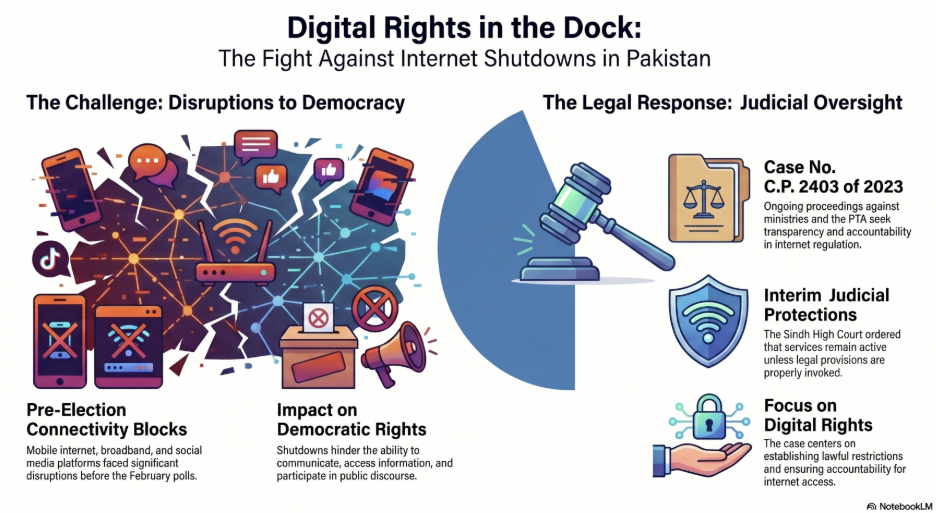
Internet Shutdowns and Access to Social Media
Case No.: C.P. No. 2403 of 2023
Court: Sindh High Court
Lawyer: Jibran Nasir
Status: Ongoing
PILAP filed proceedings before the Sindh High Court against relevant ministries and the Pakistan Telecommunication Authority over disruptions to mobile internet, broadband services, and access to social media platforms in the run-up to the February 8 polls.
The petition raised concerns that restrictions on internet access and social media platforms directly affect citizens’ ability to communicate, access information, participate in public discourse, and exercise democratic rights. The Sindh High Court issued interim directions requiring that there should be no disruption or shutdown of mobile phone, internet, or broadband services unless the applicable legal provisions were properly invoked.
The matter remains an important digital rights case concerning lawful restrictions, transparency, and accountability in the regulation of internet access.
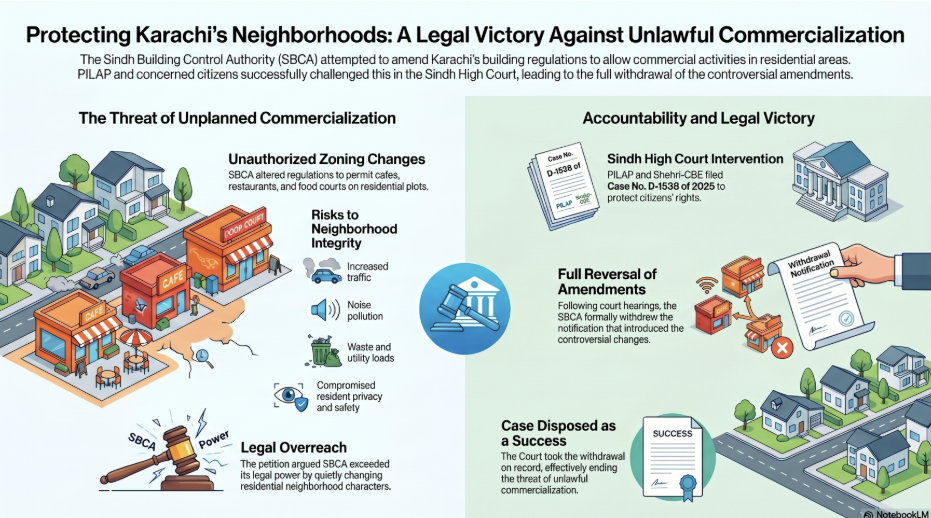
Protecting Residential Neighbourhoods from Unlawful Commercialisation
Case No.: C.P. No. D-1538 of 2025
Court: Sindh High Court
Lawyer: Zahid F. Ebrahim
Status: Litigation Win/ Impugned notification withdrawn by SBCA
One of PILAP’s important urban governance success stories is its challenge to the controversial amendments made by the Sindh Building Control Authority to the Karachi Building and Town Planning Regulations, 2002. The case was filed before the Sindh High Court as C.P. No. D-1538 of 2025, with PILAP, in collaboration with Shehri-Citizens for a Better Environment and concerned citizens, challenging changes that could have allowed commercial activities inside residential areas.
The case raised a simple but important public interest question: can a public authority quietly change the character of residential neighbourhoods without lawful authority and without protecting the rights of the people who live there?
PILAP’s petition argued that SBCA had exceeded its legal powers by altering the meaning of “residential use” and introducing “recreational use” in a manner that could permit cafes, restaurants, food courts, and similar commercial activities on residential plots. PILAP highlighted that such changes would disturb peaceful neighbourhoods, increase traffic, noise, waste, parking pressure, and utility load, while affecting the safety, privacy, and quality of life of residents.
This case was important because it was not only about buildings or land use. It was about the right of citizens to live in safe, peaceful, and properly planned communities. PILAP used its platform to bring together concerned residents and public-spirited citizens who wanted to protect Karachi’s residential areas from unplanned commercialisation.
When the petitions came up for hearing, SBCA informed the Sindh High Court that it had reviewed and reconsidered its earlier decision. SBCA then formally withdrew the impugned notification that had introduced the controversial amendments. The Court took SBCA’s statement and the withdrawal notification on record, and because the challenged notification had been reversed, the connected petitions were disposed of.
Read Judgement/Order here:
Enforcement of Article 25-A / Free and Compulsory Education
Case No.: C.P. No. 1267 of 2016
Court: Sindh High Court
Lawyer: Muhammad Najeeb Jamali
Handled by: Dr. Amjad Waheed
Status: Ongoing
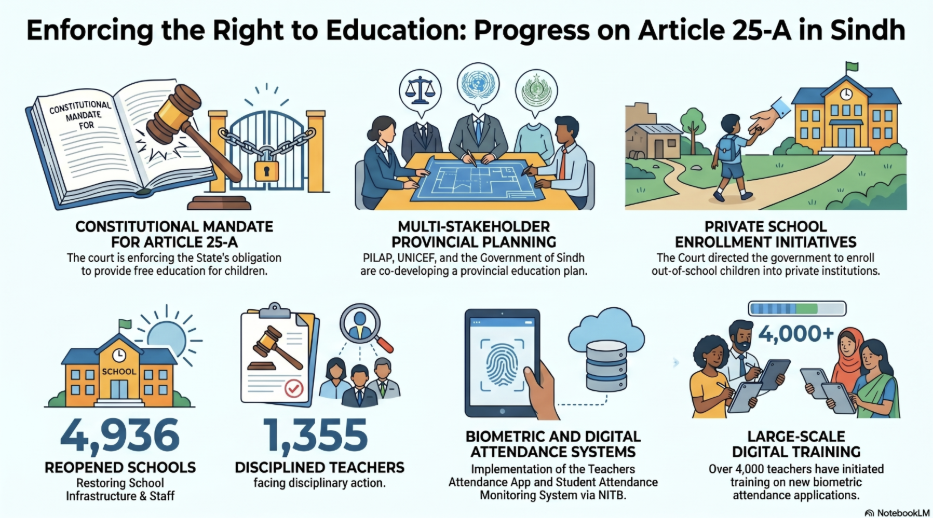
PILAP filed this petition before the Sindh High Court to seek implementation of Article 25-A of the Constitution, which guarantees free and compulsory education for children. The case focuses on the State’s obligation to ensure access to education for children between the ages of 5 and 16.
The petition has led to meaningful engagement with government authorities and education stakeholders. The Sindh High Court directed the Government of Sindh to work with PILAP for the enrolment of out-of-school children in private schools. PILAP was also made part of a Court-appointed process to assist in developing a provincial education plan.
As part of the wider reform effort, PILAP representatives contributed to consultations with UNICEF and the School Education and Literacy Department, Government of Sindh, on improving enrolment and addressing the challenge of out-of-school children.
During the proceedings, the Education Department reported several measures, including the rollout of a Teachers Attendance App in selected districts, development of a Student Attendance Monitoring System in collaboration with NITB and PITB, reopening of 4,936 schools, and disciplinary action against 1,355 absconding teachers. The Court also examined concerns around teacher absenteeism, with attendance data showing gaps that required further investigation by the Education and IT Departments.
A key focus of the proceedings has been the use of digital monitoring systems to improve accountability in the education sector. The IT Department reported that district-wise attendance features had been added to the NITB app and were being tested in seven districts. Training for more than 4,000 teachers on the biometric attendance app was also initiated, with the remaining training and record updates expected to continue.
By November 2023, the parties proposed that related petitions be separated by subject matter so that each issue could be heard and addressed more effectively. The matter remains significant for ensuring implementation of Article 25-A, improving school governance, reducing teacher absenteeism, protecting vulnerable children, and strengthening access to education across Sindh.
Read Judgement/Order here:
https://cases.shc.gov.pk/khi/web/index.php?r=cases%2Fview-judgments&casecode=213389
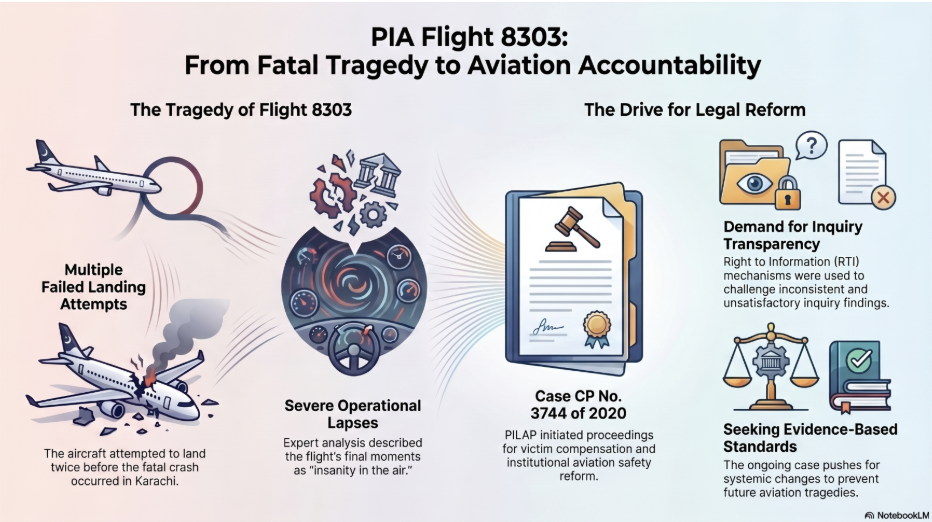
PIA Crash Victims and Aviation Safety Reform
Case No.: CP No.3744 of 2020
Court: Sindh High Court
Lawyer: Amel Khan Kansi, MTC
Status: Ongoing
PILAP initiated proceedings seeking proper compensation for victims and affected businesses following an aviation crash, along with broader reforms to prevent future accidents and improve safety processes within PIA.
The case is ongoing and reflects PILAP’s focus on aviation accountability, institutional responsibility, and public safety. It seeks to ensure that victims and affected families are treated fairly, while also pushing for improvements in aviation safety systems so that similar tragedies can be prevented in the future.
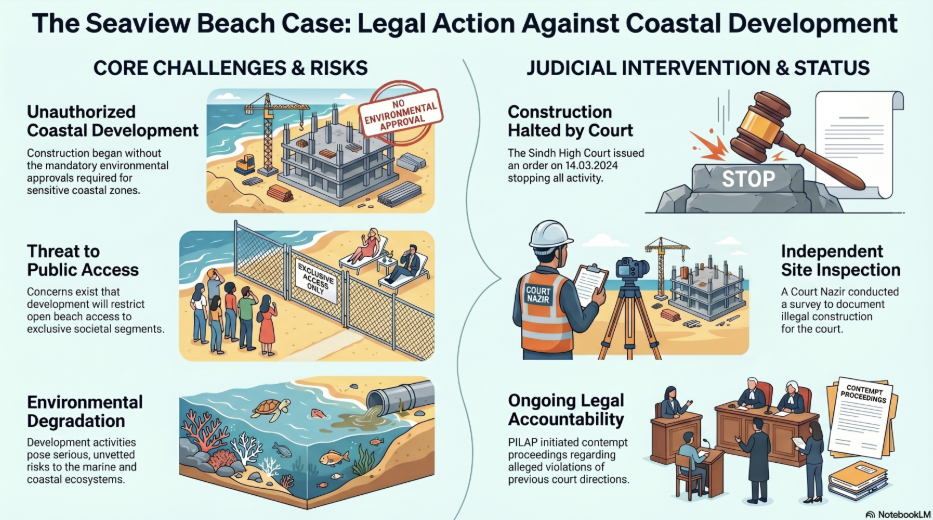
Seaview Development Project
Case No.: C.P. No. D-640 of 2022
Court: Sindh High Court
Lawyer: Advocate Zubair Ahmed Abro
Status: Ongoing / Construction halted by court order
PILAP, along with concerned citizens, challenged development activity at Seaview Beach, Karachi, undertaken by Cantonment Board Clifton without the required environmental approvals.
The petition raised two key concerns: first, that coastal development without environmental approval poses serious risks to the marine and coastal environment; and second, that such development may restrict access to an otherwise open public beach by making it exclusive to certain segments of society.
The Sindh High Court halted construction activity through its order dated 14.03.2024. A Court Nazir later conducted a survey regarding illegal construction, and the report was placed before the court. PILAP has also initiated contempt proceedings regarding alleged violation of court directions.
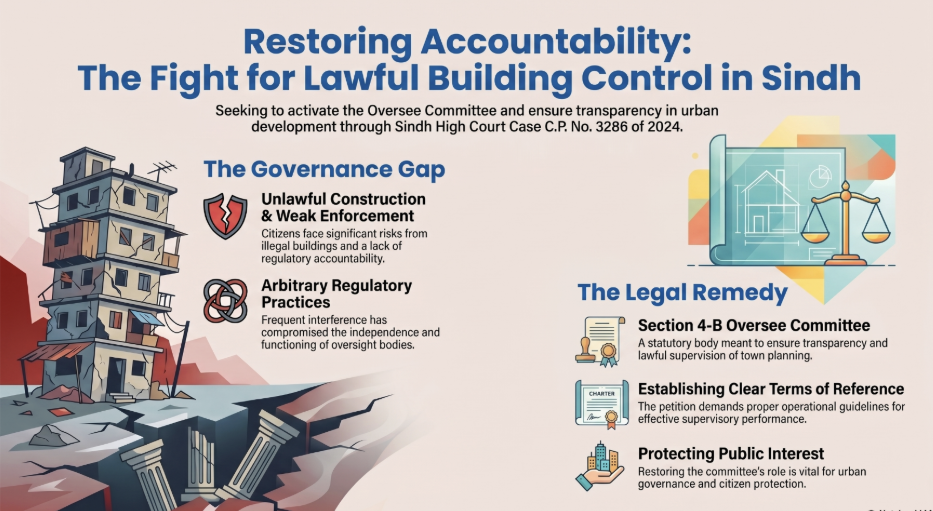
Oversee Committee / SBCA Governance
Case No.: C.P. No. 3286 of 2024
Court: Sindh High Court
Lawyer: Advocate Basil Malik
Status: Ongoing
This petition concerns the effective functioning of the Oversee Committee under Section 4-B of the Sindh Buildings Control Ordinance, 1979. The Oversee Committee is meant to ensure transparency, regulatory compliance, and lawful supervision of building control and town planning matters in Sindh.
PILAP’s involvement supports efforts to address illegal construction, arbitrary regulatory practices, and repeated interference in the constitution and functioning of oversight bodies. The petition seeks to ensure that the Oversee Committee operates under proper terms of reference and is able to perform its supervisory role effectively.
The case is significant for urban governance, public accountability, and the protection of citizens affected by unlawful construction and weak enforcement of building laws.
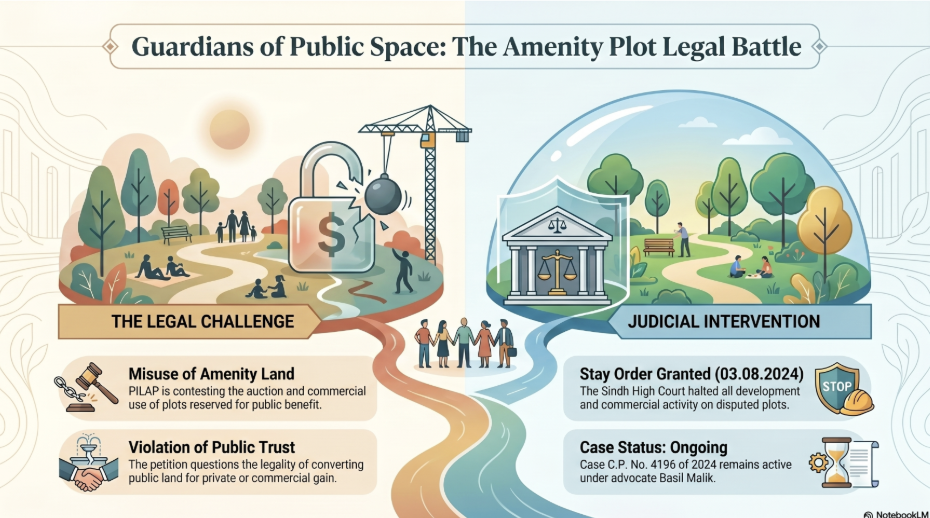
Amenity Plots / KMC Auction
Case No.: C.P. No. 4196 of 2024
Court: Sindh High Court
Lawyer: Advocate Basil Malik
Status: Ongoing / Stay order granted
PILAP challenged the auction and proposed commercial use of amenity plots that were designated for public use. The petition questions whether such plots can lawfully be converted or sold for commercial purposes in violation of planning laws, public trust principles, and judicial precedents.
The Sindh High Court granted a stay order dated 03.08.2024, preventing further development or commercial activity on the disputed plots until the matter is finally decided.
This case is part of PILAP’s broader work on protecting public spaces, preventing misuse of amenity land, and ensuring that land reserved for public benefit is not converted for private or commercial gain.

Lloyd’s Bank Heritage Building
Case No.: C.P. No. D-3823 of 2017
Court: Sindh High Court
Lawyer: Advocate Zubair Ahmed Abro
Status: Ongoing / Stay granted
PILAP challenged proposed alterations to the historic Lloyd’s Bank building in Karachi, a protected heritage site notified by the Government of Sindh. The petition was filed after an NOC was issued permitting alterations to the building, raising concerns about the protection of cultural heritage and compliance with heritage preservation laws.
The case relies on legal protections under heritage and antiquities laws, as well as constitutional guarantees relating to lawful treatment, life, dignity, and cultural rights. PILAP’s position is that protected heritage sites cannot be altered or compromised without strict adherence to law and public interest considerations.
This matter highlights PILAP’s commitment to preserving Pakistan’s architectural and cultural heritage for future generations.
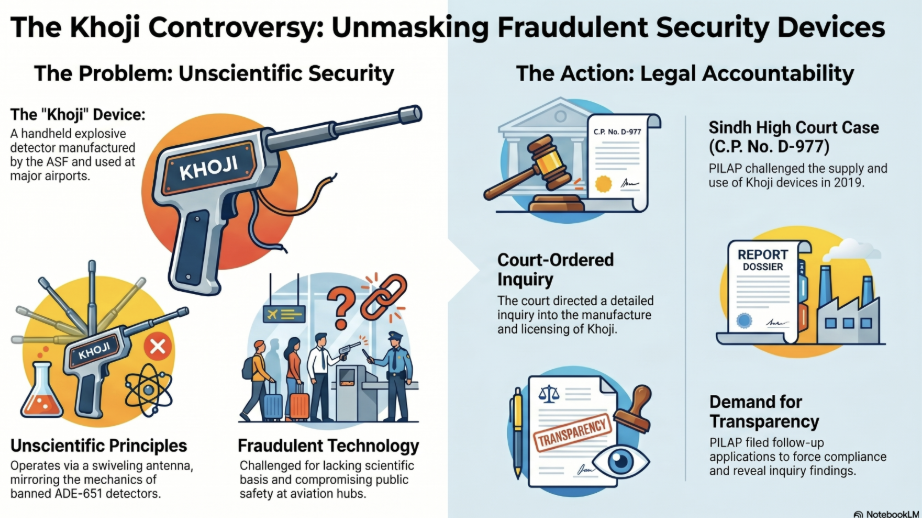
Use of Khoji Devices at Airports
Case No.: C.P. No. D-977 of 2019
Court: Sindh High Court
Lawyer: Abdul Moiz Jaferii
Status: Follow-up application filed
PILAP challenged the use and supply of fraudulent bomb detector devices, known as “Khoji” devices, by aviation security authorities. The petition questioned the manufacture, licensing, and use of such devices by the Airports Security Force and raised serious concerns regarding public safety and airport security.
The court directed that a detailed inquiry be conducted into the matter. PILAP later used Right to Information mechanisms to seek updates on the inquiry and its findings. When the response received was found to be unsatisfactory and inconsistent with the court’s directions, PILAP filed a further application in the disposed petition asking the court to require compliance and place the inquiry findings before it.
This case reflects PILAP’s role in challenging unsafe public security practices and demanding evidence-based standards in matters affecting public safety.
Read Judgement/Order here:
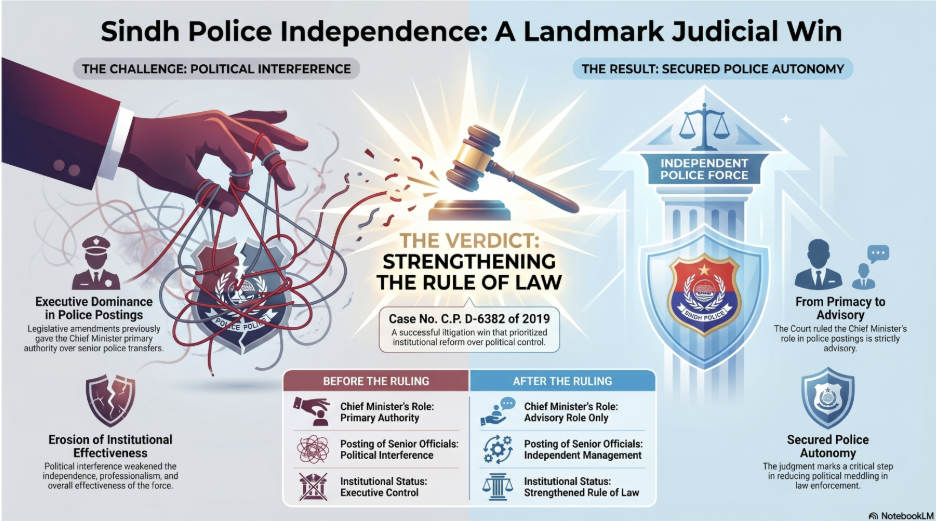
Independence of Police Force
Case No.: C.P. No. D-6382 of 2019
Court: Sindh High Court
Lawyer: Faisal Siddiqui
Status: Litigation Win
PILAP supported litigation challenging political interference in the posting and transfer of senior police officials. The case addressed concerns that executive interference weakens the independence, professionalism, and effectiveness of the police force.
The Sindh High Court struck down amendments that gave primacy to the Chief Minister in the posting of senior police officers and held that the Chief Minister’s role was advisory. The judgment was an important step toward strengthening police independence and reducing political interference in law enforcement.
This case reflects PILAP’s commitment to institutional reform, rule of law, and independent public administration.
Read Judgement/Order here: