Supreme Court

The Supreme Court of Pakistan is the highest judicial authority in Pakistan, responsible for interpreting the Constitution and ensuring justice under the law.

Court Cases
Climate Change Authority / Enforcement of Climate Change Act, 2017

Case No.: C.P. No. 42 of 2022
Court: Supreme Court of Pakistan
Lawyer: Advocate Feisal Naqvi
Status: Ongoing / Major progress achieved

PILAP, in collaboration with Advocate Feisal Naqvi, filed this petition before the Supreme Court seeking implementation of the Pakistan Climate Change Act, 2017. The petition highlighted that the Act had remained ineffective because the Pakistan Climate Change Authority had not been established, despite being required by law.

The Supreme Court took a proactive approach and issued notices to the Attorney General for Pakistan and provincial advocates general, requiring reports on steps taken to address climate change. The Court also sought assistance from experts, including submissions from Mr. Abid Qaiyum Suleria of SDPI.

A major development occurred when the Prime Minister, in his capacity as Minister-in-charge for Climate Change and Environmental Coordination, notified the establishment of the Pakistan Climate Change Authority. This followed an order dated 06.05.2024 from the Supreme Court directing establishment of the Authority within a fortnight.

Another key development in PILAP’s Climate Change Petition was the Supreme Court’s focus on provincial climate governance. The Court directed provinces to place their climate policies, action plans, budgets, and implementation measures on record.

Sindh placed its Climate Change Policy 2022 before the Court and highlighted initiatives including mangrove restoration, carbon credit trading, renewable energy investment, EV and Bio-CNG buses, flood-resilient housing, small dams, wastewater treatment, and climate-friendly agriculture.

Khyber Pakhtunkhwa referred to its Climate Change Policy 2022 and Climate Change Action Plan 2022, which include 342 strategies, with 195 adaptation and 147 mitigation measures. The province also reported major climate-related budget allocations and the establishment of a Climate Finance Unit.

Balochistan referred to its Climate Change Policy 2024 and highlighted climate initiatives including solarization of schools and agricultural tube wells, water storage schemes, groundwater projects, and construction of dams.

Punjab was initially noted as lagging behind, but the learned Advocate General, Punjab later informed the Court that the Climate Change Policy for Punjab had been notified on 03.09.2024.

These developments show that the petition helped bring provincial climate policies, budgets, and practical implementation measures under judicial review and public accountability. This case is one of PILAP’s most significant climate governance interventions, aimed at ensuring that Pakistan’s climate laws are implemented in practice rather than remaining only on paper. 

Read Judgement/Orders here:

https://scp.gov.pk/Judgment_Upload/attachments/2022/27910/judgment_06-05-2024.pdf

https://scp.gov.pk/Judgment_Upload/attachments/2022/27910/judgment_01-07-2024.pdf
Mining Operation Licenses

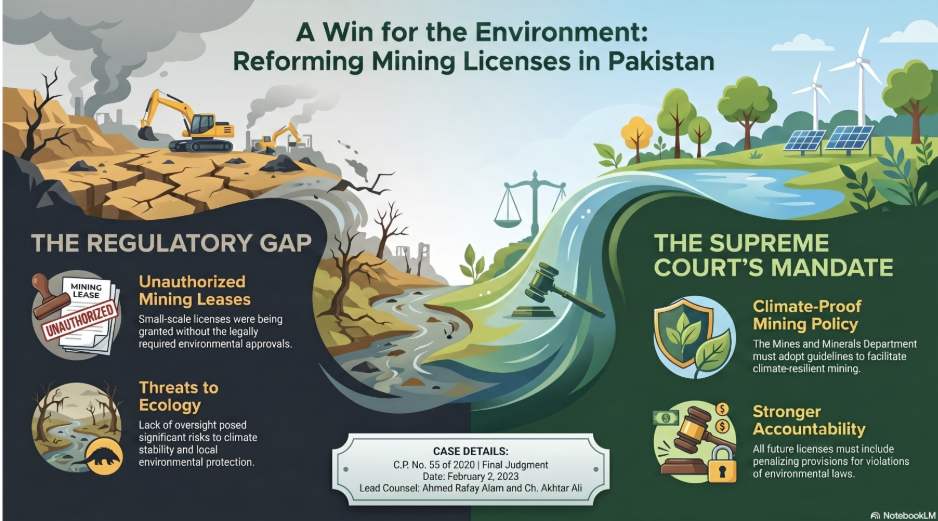
Case No.: C.P. No. 55 of 2020
Court: Supreme Court of Pakistan
Lawyers: Ahmed Rafay Alam and Ch. Akhtar Ali
Status: Litigation Win 

PILAP successfully challenged the lack of environmental approvals in the grant of small-scale mining licenses and leases. The case raised important concerns regarding environmental compliance, regulatory oversight, and the impact of mining activities on climate and ecological protection.

The Supreme Court directed the Mines and Minerals Department to adopt a climate-proof mining policy and issue proper guidelines to facilitate this process. The Court also directed that mining licenses or leases should include penalizing provisions for violations of environmental laws, ensuring stronger compliance and accountability.

This case is an important success for environmental governance, as it strengthens safeguards around mining activity and ensures that environmental protection is built directly into the licensing and lease framework.

Read Judgement/Orders here:

https://scp.gov.pk/Judgment_Upload/attachments/2020/471/detail_judgment_02-02-2023.pdf

Nuclear Safety / KANUPP II and III

Case No.: CP No.19 of 2017
Court: Supreme Court of Pakistan
Lawyer: Salahuddin Ahmed
Status: Under adjudication 

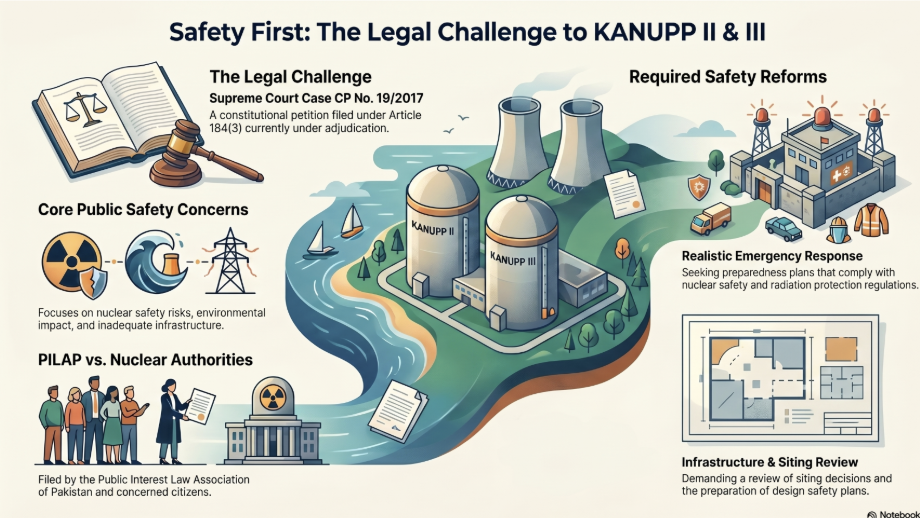
PILAP, along with concerned citizens, filed a constitutional petition under Article 184(3) of the Constitution regarding nuclear safety risks associated with KANUPP II and III.

The petition seeks, among other reliefs, a review of the siting decision, preparation of design safety plans, realistic emergency preparedness and response plans, and compliance with nuclear safety and radiation protection regulations.

The matter reflects PILAP’s concern for public safety, environmental risk, and emergency preparedness in relation to nuclear energy infrastructure, and remains under adjudication before the Supreme Court of Pakistan.

Empowering her Rights: A Digital Revolution in Women’s Rights

Project Virasat-e-Haqooq is a comprehensive strategic initiative designed to
protect and enforce the inheritance rights of women through advanced
technological and legal reforms.
Running from 2026 to 2028, the framework aims to eliminate systemic
dispossession by integrating blockchain-backed ledgers and GIS
mapping to track and secure land transfers.
The initiative focuses on closing the gap between death registrations and
property mutations while actively challenging the coerced relinquishment of
land known as Tanazul.
By utilizing class action litigation and public advocacy, the project seeks to
hold state revenue authorities accountable for negligence and record
tampering.
Ultimately, the strategy works to transform female inheritance into
an automated, tamper-proof legal right supported by transparent data and
independent legal counsel.
This multidimensional approach combines digital rights, educational
campaigns, and rigorous institutional oversight to ensure female heirs receive
their rightful entitlements.

Project Taalim: Strategic Framework for Reforming Pakistan’s Education System

This outlines a multifaceted strategy to enhance the Pakistani academic
framework through both structural and social reforms.
It emphasizes the necessity of increased financial investment and the
implementation of modernized teaching standards to foster better learning
outcomes.
The visual identifies specific goals, such as bridging gender gaps in schooling
and integrating advanced digital technologies into the classroom.
Furthermore, it advocates for stricter institutional oversight and collaborative
efforts between the state and private entities to ensure long-term progress.
By focusing on curriculum innovation and university-level research, the
source presents a comprehensive roadmap for national educational
development.

Project Shifa: Thelessemia Free Future: Ensuring Rights, Saving Lives

Project Shifa is a comprehensive legal and social initiative designed to safeguard
the rights of Thalassemia patients through institutional reform.
The program seeks to mandate advanced blood screening technologies via court
orders to prevent the transmission of infections during transfusions.
Furthermore, the strategy involves lobbying for tax exemptions on medical
supplies and establishing a centralized national database to accurately track the
prevalence of the disease.
A major pillar of the project is the implementation of compulsory pre-marital
genetic testing to curb the hereditary spread of the condition.
By holding the government accountable through litigation and policy advocacy,
the initiative aims to make life-saving treatment affordable and accessible for all
families.
These efforts collectively work toward a future where preventative laws and
healthcare standards protect the most vulnerable citizens.

Mechanizing Sanitation and Securing Worker Dignity

Project Safai, is a comprehensive initiative dedicated to ending the hazardous
practice of manual scavenging in Pakistan.
The strategy focuses on mechanizing sanitation by replacing human labor with
locally manufactured low-cost robots and specialized machinery.
Beyond technology, the project aims to transform laborers into business
owners through cooperatives, significantly increasing their monthly income and
legal protections.
A critical component of the plan includes a digital tracking system to monitor
safety logs and verify worker health before maintenance begins.
By targeting a nationwide mandate for machine-led cleaning by 2026, the
initiative seeks to eliminate workplace fatalities and restore human dignity to
minority workers.
This multifaceted approach is supported by various welfare organizations and
legal advocacy groups to ensure long-term institutional change.

Project Saaf Pani: Karachi Coastal Regeneration Strategy

This initiative outlines Project Saaf Pani, an ambitious initiative designed to
restore Karachi’s coastal ecosystem through community-led oversight and modern
technology.
The strategy emphasizes hybrid governance, utilizing local “Coastal Watch”

teams and a “Digital Toxicity Map” to hold industrial polluters accountable via real-
time data and legal action.

To address contamination, the plan proposes nature-based solutions, such as
using seaweed for bioremediation, which simultaneously cleans the water and
creates economic opportunities for fishing families.
By filing Public Interest Litigation and transparency requests, the project aims to
mandate the installation of waste treatment plants across industrial zones.
Ultimately, these efforts seek to transform the harbor by combining legal advocacy,
scientific research, and public awareness campaigns to eliminate marine pollution.

This comprehensive framework focuses on measurable outcomes to ensure the long-
term health and economic viability of the region’s maritime environment.

Project Rahbar: Reforming Pakistan's Juvenile Justice System

Project Rahbar is a comprehensive initiative designed to reform Pakistan’s
juvenile justice system by ensuring the legal and physical protection of minors.
The project aims to end the incarceration of children in adult facilities by
enforcing existing laws, such as the Juvenile Justice System Act of 2018.
Key strategies include operationalizing local justice committees,
integrating digital age-verification systems with national databases, and
establishing specialized observation homes managed by NGOs.
Furthermore, the initiative seeks to eliminate financial barriers to justice by
providing legal aid and bail support for impoverished youth.
Through litigation, advocacy, and social media campaigns, the project focuses
on shifting the legal framework from a punitive approach to one centered
on rehabilitation and child welfare.

Project Rabta: A Blueprint for Digital Rights and Accountability

Project Rabta outlines a comprehensive strategic framework aimed at
establishing stable internet access as a protected civil right in Pakistan.
The initiative utilizes a combination of strategic litigation, legislative
advocacy, and public transparency to hold the national regulator accountable
for service disruptions and shutdowns.
Key milestones include securing a landmark court ruling by 2026 to
link connectivity with the right to trade and mandating automatic
consumer refunds for poor service quality.
By leveraging Right to Information requests and independent expert
veriDication, the project seeks to challenge government data and
ensure corporate accountability for connectivity standards.
Ultimately, the plan empowers citizens through social media activism and
educational workshops to demand a more transparent and reliable digital
infrastructure.

Project Qanooni-Infaaz: Bridging the Judicial Implementation Gap

Project Qanooni-Infaaz is a strategic judicial reform initiative designed to bridge
the gap between legal victories and actual enforcement on the ground.
The program outlines a multi-year roadmap starting in 2026 to
identify government bottlenecks and use aggressive litigation, such as contempt
proceedings, to force state compliance.
By utilizing RTI applications and public audits, the project aims to expose
administrative inertia and hold speciBic ofBicials accountable for ignoring court
orders.
Ultimately, the initiative seeks to integrate judicial directives into permanent
policy and standard operating procedures within state departments.
To ensure long-term success, a dedicated Judicial Compliance Unit will be
established to provide continuous monitoring and public updates on the status of
high-impact reforms.
This systematic approach ensures that court-ordered protections for human rights
and safety are fully realized rather than remaining mere paper triumphs.

Project Muhafiz-e-Cyber: Decentralised Child Protection Strategies

Project Muhafiz-e-Cyber is a comprehensive strategic framework designed to
combat online child sexual exploitation through decentralized monitoring and
improved legal pathways.
The initiative aims to empower local communities and schools by establishing
“Cyber Watch” units and “Safe Screen” centers to bridge the gap between reporting
and formal investigations.
By implementing digital reporting kiosks and automated computer systems, the
project seeks to eliminate geographical barriers and administrative inefficiencies
that often lead to lost abuse reports.
Through a combination of targeted litigation, public advocacy, and social media
campaigns, the strategy works to dismantle the social stigma surrounding digital
crimes.

Ultimately, the project strives for official government recognition of community-
led monitoring and the integration of secure, trauma-informed support systems

within the educational landscape.

These efforts are focused on ensuring swift justice and continuous protection for
young victims in the digital age.

Systemic Reform of Nikah Nama Registration

Project Muhafiz-e-Haqooq is a comprehensive initiative designed to
safeguard women’s legal rights within marriage contracts through systemic
reform and digital modernization.
The project aims to eliminate the unauthorized removal of vital contractual clauses,
such as the right to divorce, by transitioning to a mandatory digital registration
system for marriage officers.
These efforts are supported by professional certification requirements and
biometric verification to ensure registrars are held legally accountable for their
duties.
Additionally, the initiative focuses on financial autonomy by pursuing litigation
that holds the state liable for administrative errors that deprive women of
their dowry or inheritance.
Through widespread educational campaigns and university workshops, the
project seeks to empower brides with the knowledge necessary to
negotiate informed consent.
Ultimately, the strategy combines legal advocacy, technological solutions, and
social awareness to ensure the Nikah Nama serves as a protected legal document
for all women.

Project Mahfooz: A Framework for Pakistan’s Digital Rights Reform

Project Mahfooz is a strategic initiative designed to establish a robust data
protection framework in Pakistan by securing the enactment of comprehensive
privacy laws.
The initiative seeks to elevate personal privacy to a fundamental human right,
ensuring that state digital systems integrate “Privacy-by-Design” principles from
their inception.
Through a combination of legal advocacy, research, and litigation, the project
aims to hold both government and private entities financially accountable for
security breaches and data negligence.
Furthermore, it focuses on creating an independent regulatory body to oversee
data usage and eliminate the digital exclusion caused by administrative errors in
identity systems.
By 2028, the program intends to reduce the arbitrary blocking of citizens’ services
and guarantee that personal information is treated with the dignity it deserves.

Project Adliya: Accountability and Access to Justice

Project Adliya is a comprehensive strategic framework designed to transform the
legal system by increasing judicial accountability and expanding public access to
justice.
The initiative seeks to implement a public reporting system by 2026 to track
court spending and the resolution of citizen complaints.
To decrease the burden of high legal costs and long delays, the plan proposes the
establishment of mediation centers and the operationalization of alternative
dispute resolution laws.
A significant portion of the project focuses on vulnerable populations, aiming to
secure pro bono legal services and create dedicated support centers for
women within court complexes.
Through a combination of public interest litigation, data-driven research,
and social media advocacy, the project intends to make the judiciary more
transparent and affordable for all citizens.