



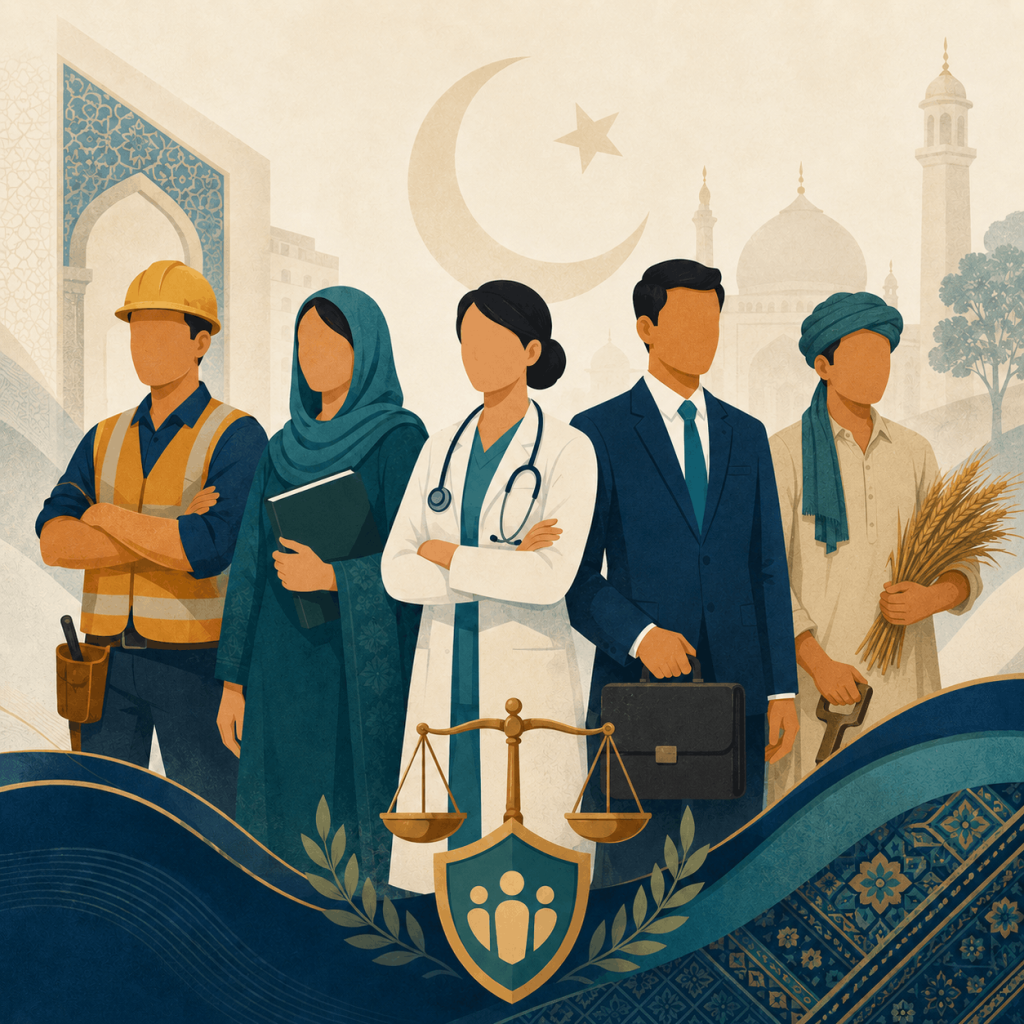





Practical Guide to Constitutional Rights

These practical guides explain common problems citizens face and connect them with the relevant constitutional rights. Each guide helps you understand what your right means, what kind of issue may fall under it, and what steps you can take.

Legal Rights and Access to Justice

Arrest, detention, fair trial, due process, misuse of authority, unconstitutional laws, forced confession, unlawful punishment, unfair government action, and access to courts.

Women’s Rights

Equality, dignity, safety, harassment, violence, employment discrimination, access to public spaces, inheritance, education, and protection from abuse.

Minority Rights

Religious freedom, protection from discrimination, worship rights, school safeguards, public services, employment, and cultural identity.

Children’s Rights

Education, child labour, protection from violence, abuse, exploitation, forced labour, discrimination, and safe development.

Marriage and Family Rights

Forced marriage, consent, dignity, privacy, family protection, women’s safety, children’s welfare, and discrimination within family or community settings.

Work and Employment Rights

Right to lawful work, fair access to employment, protection from forced labour, child labour, discrimination, unfair termination, and workplace exploitation.

Digital Rights and Privacy

Online privacy, data misuse, unlawful surveillance, online harassment, social media restrictions, digital expression, and access to information.

Environment and Climate Rights

Clean air, safe water, pollution, waste management, climate change, public parks, forests, rivers, floods, heatwaves, and environmental decision-making.

Education Rights

School access, free education, admissions, public school quality, religious safeguards, inclusive education, and student protection.

Housing, Property and Land Rights

Property ownership, housing, eviction, demolition, land grabbing, inheritance, public land, compensation, and displacement.

Freedom of Speech and Civic Participation

Speech, peaceful protest, public meetings, political participation, unions, associations, journalism, and public accountability.

Health Rights

Access to healthcare, public hospitals, safe water, food safety, public health failures, disease prevention, emergency care, and health-related state negligence.

Legal Rights and Access to Justice

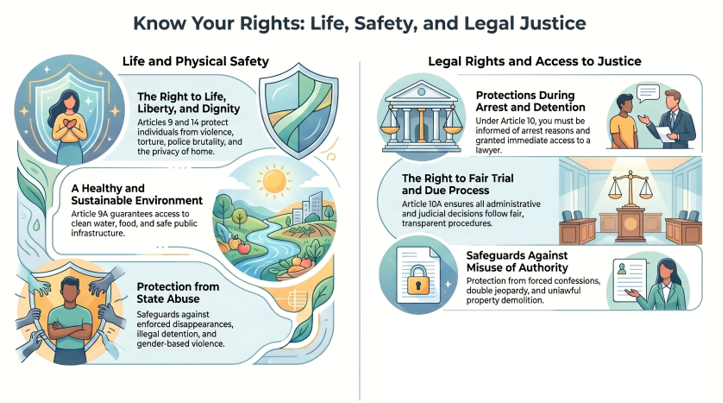
These outlines the essential legal protections and constitutional rights concerning the physical safety and judicial treatment of citizens.

It categorizes various risks to human life, ranging from state-sponsored violence and illegal detention to environmental hazards like unsafe water or failing infrastructure.

Furthermore, the source emphasizes the necessity of due process, ensuring individuals are protected against unfair government actions, administrative overreach, and the denial of a fair trial.

By highlighting specific articles, the document serves as a guide for identifying human rights violations in both public services and the criminal justice system.

Ultimately, these excerpts define the state’s obligation to maintain public dignity and safeguard the fundamental liberties of its people.

Relevant Rights

Isssues Covered:

  • Protection from illegal arrest 
  • Protection from unlawful detention 
  • Right to be informed of reasons for arrest 
  • Right to access a lawyer 
  • Protection from detention without court production 
  • Protection from forced confession 
  • Protection from torture during investigation 
  • Protection from being punished twice for the same offence 
  • Protection from punishment under laws applied backward 
  • Right to fair trial and due process 
  • Government action without notice or hearing 
  • Administrative decisions passed without fair procedure 
  • Unfair disciplinary action by public institutions 
  • Job termination without inquiry 
  • Student expulsion without hearing 
  • Admission denied without reason 
  • Demolition, eviction, or cancellation orders without due process 
  • Misuse of police or government authority 
  • Challenging unconstitutional laws, policies, or state actions

Women’s Rights

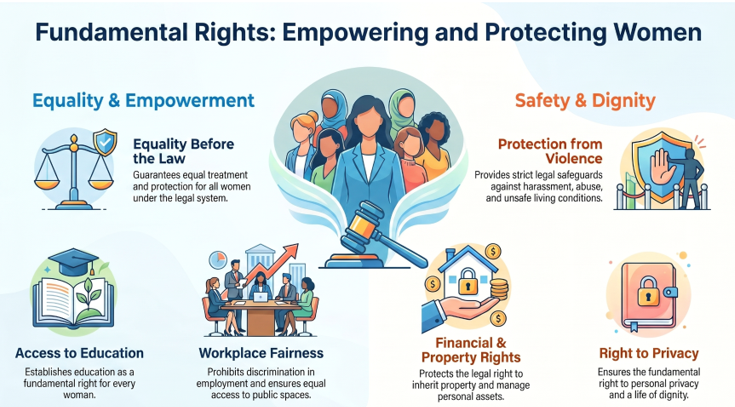
This outlines the fundamental legal protections and civil liberties guaranteed to women according to specific constitutional articles.

It emphasizes the importance of gender equality, ensuring that women have equal standing before the law and unrestricted access to both education and public spaces.

The text details critical safeguards against harassment, violence, and abuse to ensure personal safety and the preservation of human dignity.

Furthermore, it addresses economic fairness by advocating for inheritance rights and the removal of discriminatory barriers in professional environments.

Ultimately, these guidelines establish a comprehensive framework for protecting the autonomy and security of women in both private and public life.

Relevant Rights

Isssues Covered:

  • Protection from harassment and violence 
  • Right to dignity and privacy 
  • Equal treatment before law 
  • Women’s right to education 
  • Women’s right to inheritance and property 
  • Discrimination at work or in public employment 
  • Access to public places without discrimination 
  • Protection from forced or unsafe living conditions

Minority Rights

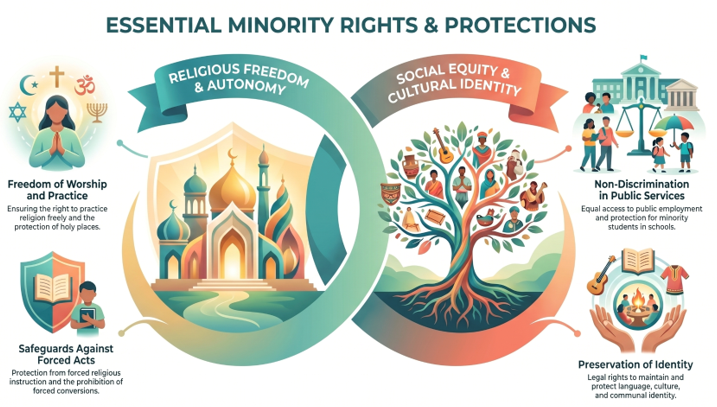
This outlines a framework of fundamental protections designed to safeguard the interests of marginalized communities.

These provisions ensure that individuals can freely practice their faith and preserve their unique cultural and linguistic identities without fear of interference.

The documents specifically prohibit religious discrimination within public sectors, such as government employment and educational institutions.

Furthermore, the source highlights legal barriers against forced conversions and the desecration of sacred places of worship.

By establishing these civic safeguards, the text illustrates a commitment to maintaining social equality and individual liberty.

Overall, the articles serve as a comprehensive guide to upholding the human rights of minority groups within a diverse society.

Relevant Rights

Isssues Covered:

  • Right to practice religion freely 
  • Protection from forced religious instruction 
  • Discrimination against minority students 
  • Protection of places of worship 
  • Religious discrimination in public services 
  • Minority access to public employment 
  • Protection from forced conversions 
  • Preservation of language, culture, and identity 

Children’s Rights

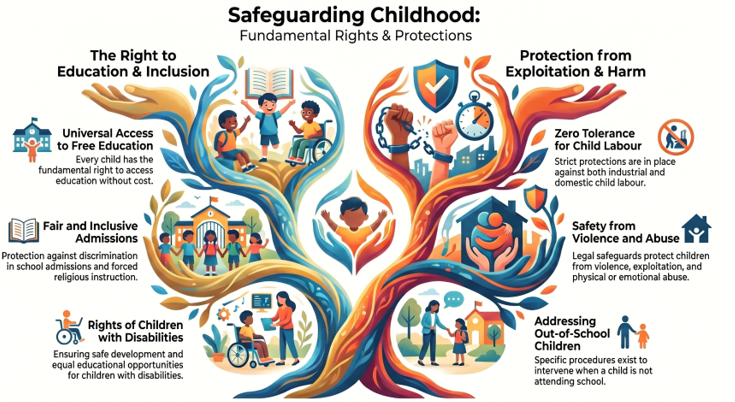
This document details the fundamental legal protections and entitlements afforded to minors, emphasizing their right to a safe development.

A primary focus is placed on educational access, ensuring that children can attend school without facing discrimination or being coerced into religious instruction.

The text also highlights the necessity of shielding youth from harmful practices like forced labor, domestic servitude, and various forms of abuse or exploitation.

Additionally, it addresses the specific needs and rights of children with disabilities to ensure they are not marginalized.

By outlining these specific articles, the source provides a clear framework for identifying and addressing violations of children’s rights.

Overall, the material serves as a guide for protecting the well-being and future of all young citizens.

Relevant Rights

Isssues Covered:

  • Every child’s right to free education 
  • Protection from child labour 
  • Protection from domestic child labour 
  • Protection from abuse, violence, and exploitation 
  • Rights of children with disabilities 
  • Discrimination in school admissions 
  • Protection from forced religious instruction 
  • What to do if a child is out of school

Marriage and Family Rights

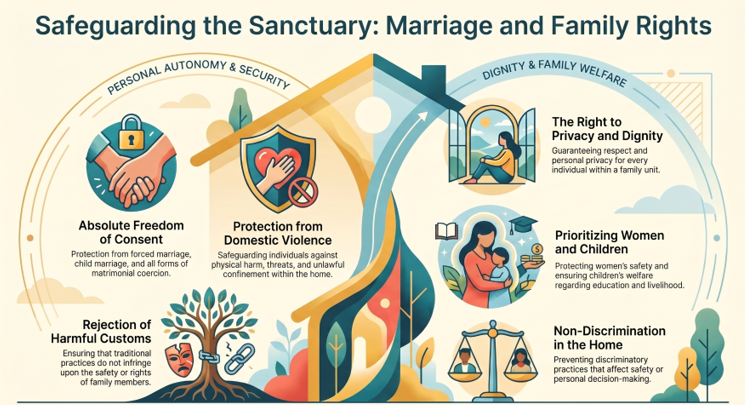
This umbrella of articles cover the legal and ethical protections designed to safeguard the integrity of the family unit and its individual members.

It emphasizes the necessity of mutual consent, specifically prohibiting forced or child marriage while promoting the fundamental right to personal dignity.

A significant portion of the text focuses on ensuring safety from domestic violence and eliminating harmful cultural practices that threaten women and children.

Furthermore, the source advocates for the preservation of private life and the prevention of unlawful coercion regarding personal livelihood or education.

By prioritizing equality and welfare, these guidelines aim to dismantle discrimination within domestic and community settings.

Ultimately, the material serves as a framework for protecting human rights against threats and confinement in the pursuit of a secure family environment.

Relevant Rights

Isssues Covered:

  • Protection from forced marriage 
  • Right to dignity and privacy in family life 
  • Protection from domestic violence 
  • Protection from harmful customs 
  • Women’s safety within marriage and family 
  • Child marriage concerns 
  • Family decisions affecting education, livelihood, or safety 
  • Protection from coercion, threats, or unlawful confinement

Work and Employment Rights

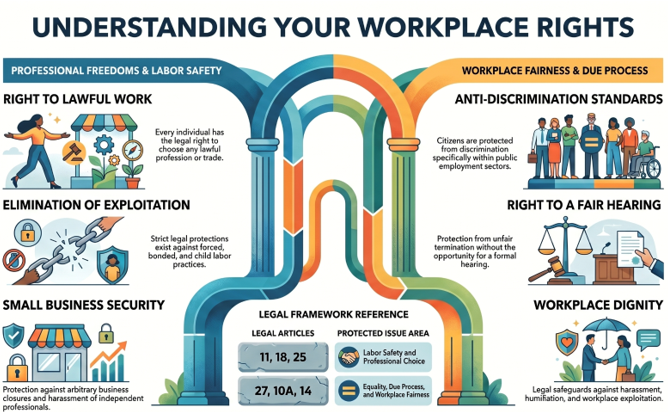
It outlines the fundamental legal protections and workplace rights guaranteed to individuals within a professional environment.

It emphasizes the freedom for citizens to pursue lawful employment while strictly prohibiting abusive practices such as forced labor and child exploitation.

The text details safeguards against discriminatory hiring and ensures that employees are shielded from unfair dismissal or workplace harassment.

Furthermore, it addresses the necessity of protecting small businesses and professionals from arbitrary closures or systemic interference.

By citing specific legal articles, the source establishes a framework for fair treatment and dignity across all sectors of the economy.

Relevant Rights

Isssues Covered:

  • Right to choose lawful work or profession 
  • Protection from forced labour and bonded labour 
  • Protection from child labour 
  • Discrimination in public employment 
  • Unfair termination without hearing 
  • Workplace harassment or humiliation 
  • Arbitrary closure of workplace or business 
  • Harassment of small businesses and professionals

Digital Rights and Privacy

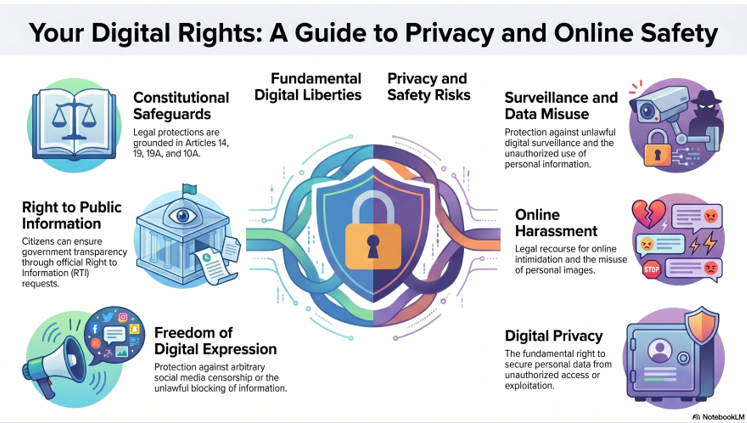
This covers the fundamental legal protections and challenges associated with the modern internet landscape.

It specifically addresses how individuals are shielded from online harassment, intimidation, and the unauthorized use of their personal images or data.

Furthermore, the source examines the critical boundaries of government surveillance and social media censorship to ensure that digital expression remains free.

A significant emphasis is placed on the right to access public information, highlighting how transparency is maintained through formal requests.

By referencing specific legal articles, the text serves as a framework for understanding digital rights and individual privacy in a connected society.

Relevant Rights

Isssues Covered:

  • Protection from online harassment 
  • Misuse of personal data or images 
  • Unlawful surveillance 
  • Digital privacy and personal information 
  • Social media censorship or blocking 
  • Online intimidation 
  • Right to access public information 
  • Government transparency through RTI requests 

Environment and Climate Rights

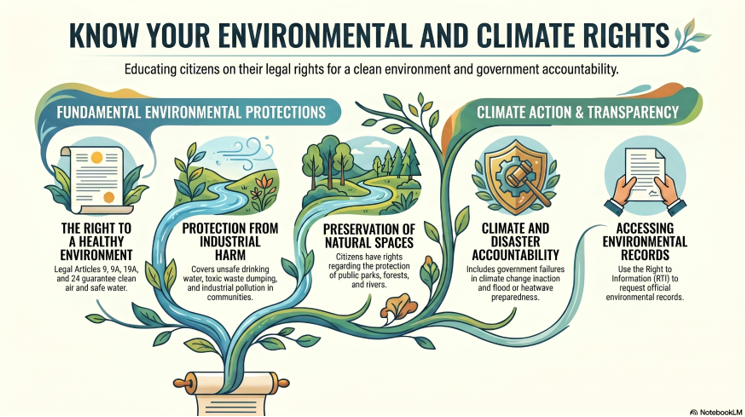
This outlines the fundamental entitlements to a clean and healthy environment, specifically referencing legal protections against various forms of ecological degradation.

It addresses critical public health concerns such as polluted air, toxic waste disposal, and contaminated drinking water that threaten local communities.

The text further examines the responsibilities of authorities regarding climate change mitigation, including the management of extreme weather events like floods and heatwaves.

Additionally, it highlights the importance of preserving natural resources such as forests and public parks from industrial damage and deforestation.

Finally, the source provides guidance on how citizens can participate in environmental decision-making by accessing official records through transparency laws.

These combined elements establish a comprehensive framework for understanding and defending ecological and climate-related rights.

Relevant Rights

Isssues Covered:

  • Right to clean and healthy environment 
  • Unsafe drinking water 
  • Air and water pollution 
  • Industrial pollution affecting communities 
  • Toxic waste dumping 
  • Deforestation and damage to public parks 
  • Climate change inaction 
  • Flood and heatwave preparedness failures 
  • How to ask for environmental records through RTI 

Health Rights

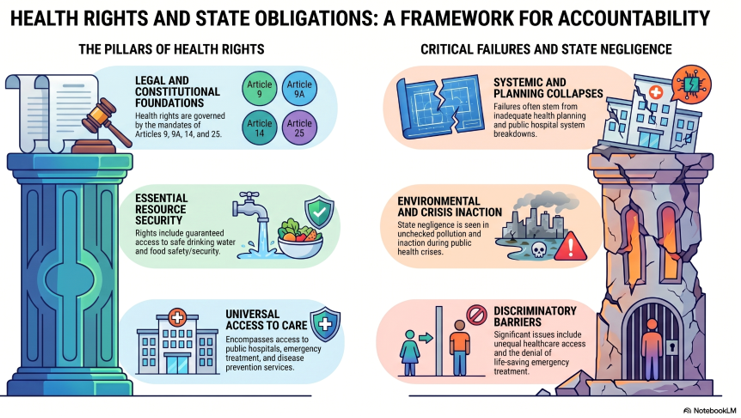
This outlines the fundamental legal framework and state obligations regarding public health and safety.

It details critical protections such as the right to emergency medical care and the necessity of maintaining functional public hospital systems.

Beyond clinical settings, the document emphasizes the state’s duty to provide safe drinking water, food security, and pollution control to protect citizens.

It also addresses legal accountability for government negligence, specifically focusing on failures in disaster planning and crisis management.

Ultimately, these regulations aim to ensure equitable healthcare access and prevent systemic failures that jeopardize community well-being.

Relevant Rights

Isssues Covered:

  • Failure of public hospitals or health systems 
  • Denial of emergency treatment 
  • Unsafe drinking water affecting health 
  • Pollution affecting public health 
  • Food insecurity and malnutrition 
  • Lack of public health planning 
  • Unequal access to healthcare 
  • State inaction during public health crises

Education Rights

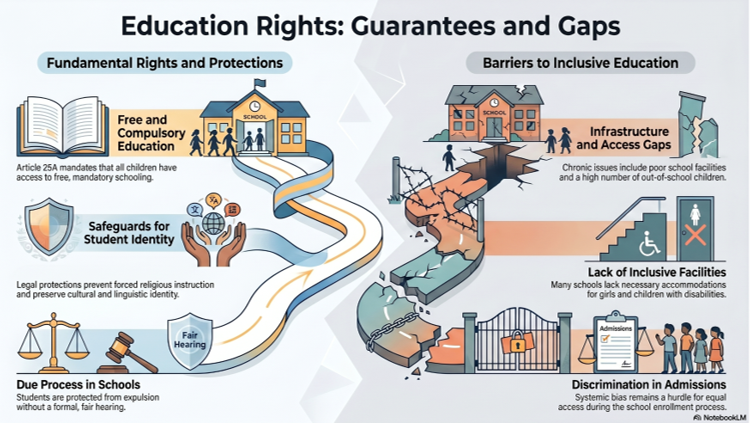
This details the legal framework and fundamental human rights associated with the educational system.

It highlights the state’s obligation to provide free and mandatory schooling while addressing critical barriers like dilapidated infrastructure and the high number of out-of-school youth.

The text emphasizes the necessity of inclusive environments, specifically advocating for improved resources for female students and children with disabilities.

Furthermore, it outlines protections against religious coercion and discriminatory admission practices to ensure equitable access for all.

By referencing specific legal articles, the source establishes a mandate for fair disciplinary procedures and the preservation of cultural and linguistic identities.

Ultimately, these guidelines serve as a comprehensive blueprint for upholding educational equity and student safety.

Relevant Rights

Isssues Covered:

  • Failure of public hospitals or health systems 
  • Denial of emergency treatment 
  • Unsafe drinking water affecting health 
  • Pollution affecting public health 
  • Food insecurity and malnutrition 
  • Lack of public health planning 
  • Unequal access to healthcare 
  • State inaction during public health crises

Housing, Property and Land Rights

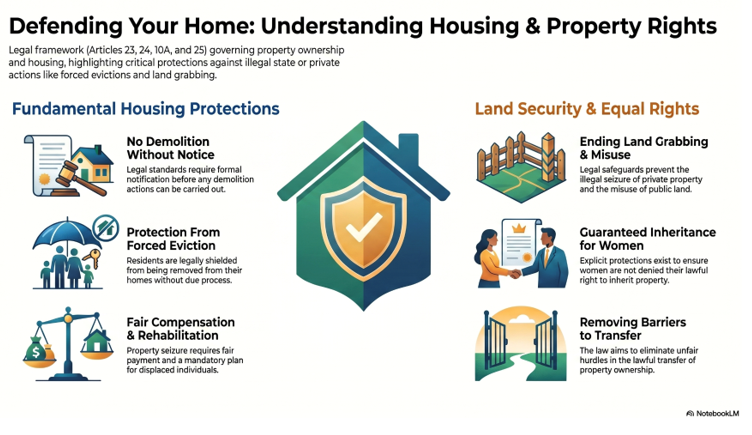
This outlines the fundamental legal protections and systemic challenges associated with housing and property rights.

It specifically addresses the prevention of unlawful evictions and the destruction of property without proper notification or financial restitution.

The text also highlights critical social inequities, such as gender-based inheritance denial and the forced displacement of individuals without rehabilitation support.

Furthermore, it examines the misuse of public land and the presence of obstacles that prevent the legal transfer of ownership.

Ultimately, these articles serve as a framework for safeguarding citizens against land grabbing and exploitative development projects.

Relevant Rights

Isssues Covered:

  • Protection from forced eviction 
  • Demolition without notice 
  • Property taken without compensation 
  • Land grabbing 
  • Women denied inheritance 
  • Displacement without rehabilitation 
  • Public land misuse 
  • Unfair development schemes 
  • Barriers to lawful property transfer

Freedom of Speech and Civic Participation

Civic Liberty and the Right to Public Expression

The provided document details the fundamental components of freedom of expression and civic involvement within a legal framework.

It outlines essential protections for peaceful assembly and the formation of unions or associations, which allow citizens to organize effectively.

The text also emphasizes the importance of political participation and the right to hold public authorities accountable through criticism and information requests.

Furthermore, it addresses significant threats to these liberties, such as media censorship, harassment of journalists, and limitations on movement.

By referencing specific legal articles, the source establishes a formal basis for transparency and the protection of democratic engagement.

Overall, the material serves as a comprehensive overview of the rights and challenges associated with public discourse and activism.

Relevant Rights

Isssues Covered:

  • Right to peaceful protest 
  • Right to form associations or unions 
  • Right to political participation 
  • Restrictions on movement 
  • Censorship and media harassment 
  • Threats to journalists 
  • Right to criticize public authorities 
  • Right to ask for public records

Empowering her Rights: A Digital Revolution in Women’s Rights

Project Virasat-e-Haqooq is a comprehensive strategic initiative designed to
protect and enforce the inheritance rights of women through advanced
technological and legal reforms.
Running from 2026 to 2028, the framework aims to eliminate systemic
dispossession by integrating blockchain-backed ledgers and GIS
mapping to track and secure land transfers.
The initiative focuses on closing the gap between death registrations and
property mutations while actively challenging the coerced relinquishment of
land known as Tanazul.
By utilizing class action litigation and public advocacy, the project seeks to
hold state revenue authorities accountable for negligence and record
tampering.
Ultimately, the strategy works to transform female inheritance into
an automated, tamper-proof legal right supported by transparent data and
independent legal counsel.
This multidimensional approach combines digital rights, educational
campaigns, and rigorous institutional oversight to ensure female heirs receive
their rightful entitlements.

Project Taalim: Strategic Framework for Reforming Pakistan’s Education System

This outlines a multifaceted strategy to enhance the Pakistani academic
framework through both structural and social reforms.
It emphasizes the necessity of increased financial investment and the
implementation of modernized teaching standards to foster better learning
outcomes.
The visual identifies specific goals, such as bridging gender gaps in schooling
and integrating advanced digital technologies into the classroom.
Furthermore, it advocates for stricter institutional oversight and collaborative
efforts between the state and private entities to ensure long-term progress.
By focusing on curriculum innovation and university-level research, the
source presents a comprehensive roadmap for national educational
development.

Project Shifa: Thelessemia Free Future: Ensuring Rights, Saving Lives

Project Shifa is a comprehensive legal and social initiative designed to safeguard
the rights of Thalassemia patients through institutional reform.
The program seeks to mandate advanced blood screening technologies via court
orders to prevent the transmission of infections during transfusions.
Furthermore, the strategy involves lobbying for tax exemptions on medical
supplies and establishing a centralized national database to accurately track the
prevalence of the disease.
A major pillar of the project is the implementation of compulsory pre-marital
genetic testing to curb the hereditary spread of the condition.
By holding the government accountable through litigation and policy advocacy,
the initiative aims to make life-saving treatment affordable and accessible for all
families.
These efforts collectively work toward a future where preventative laws and
healthcare standards protect the most vulnerable citizens.

Mechanizing Sanitation and Securing Worker Dignity

Project Safai, is a comprehensive initiative dedicated to ending the hazardous
practice of manual scavenging in Pakistan.
The strategy focuses on mechanizing sanitation by replacing human labor with
locally manufactured low-cost robots and specialized machinery.
Beyond technology, the project aims to transform laborers into business
owners through cooperatives, significantly increasing their monthly income and
legal protections.
A critical component of the plan includes a digital tracking system to monitor
safety logs and verify worker health before maintenance begins.
By targeting a nationwide mandate for machine-led cleaning by 2026, the
initiative seeks to eliminate workplace fatalities and restore human dignity to
minority workers.
This multifaceted approach is supported by various welfare organizations and
legal advocacy groups to ensure long-term institutional change.

Project Saaf Pani: Karachi Coastal Regeneration Strategy

This initiative outlines Project Saaf Pani, an ambitious initiative designed to
restore Karachi’s coastal ecosystem through community-led oversight and modern
technology.
The strategy emphasizes hybrid governance, utilizing local “Coastal Watch”

teams and a “Digital Toxicity Map” to hold industrial polluters accountable via real-
time data and legal action.

To address contamination, the plan proposes nature-based solutions, such as
using seaweed for bioremediation, which simultaneously cleans the water and
creates economic opportunities for fishing families.
By filing Public Interest Litigation and transparency requests, the project aims to
mandate the installation of waste treatment plants across industrial zones.
Ultimately, these efforts seek to transform the harbor by combining legal advocacy,
scientific research, and public awareness campaigns to eliminate marine pollution.

This comprehensive framework focuses on measurable outcomes to ensure the long-
term health and economic viability of the region’s maritime environment.

Project Rahbar: Reforming Pakistan's Juvenile Justice System

Project Rahbar is a comprehensive initiative designed to reform Pakistan’s
juvenile justice system by ensuring the legal and physical protection of minors.
The project aims to end the incarceration of children in adult facilities by
enforcing existing laws, such as the Juvenile Justice System Act of 2018.
Key strategies include operationalizing local justice committees,
integrating digital age-verification systems with national databases, and
establishing specialized observation homes managed by NGOs.
Furthermore, the initiative seeks to eliminate financial barriers to justice by
providing legal aid and bail support for impoverished youth.
Through litigation, advocacy, and social media campaigns, the project focuses
on shifting the legal framework from a punitive approach to one centered
on rehabilitation and child welfare.

Project Rabta: A Blueprint for Digital Rights and Accountability

Project Rabta outlines a comprehensive strategic framework aimed at
establishing stable internet access as a protected civil right in Pakistan.
The initiative utilizes a combination of strategic litigation, legislative
advocacy, and public transparency to hold the national regulator accountable
for service disruptions and shutdowns.
Key milestones include securing a landmark court ruling by 2026 to
link connectivity with the right to trade and mandating automatic
consumer refunds for poor service quality.
By leveraging Right to Information requests and independent expert
veriDication, the project seeks to challenge government data and
ensure corporate accountability for connectivity standards.
Ultimately, the plan empowers citizens through social media activism and
educational workshops to demand a more transparent and reliable digital
infrastructure.

Project Qanooni-Infaaz: Bridging the Judicial Implementation Gap

Project Qanooni-Infaaz is a strategic judicial reform initiative designed to bridge
the gap between legal victories and actual enforcement on the ground.
The program outlines a multi-year roadmap starting in 2026 to
identify government bottlenecks and use aggressive litigation, such as contempt
proceedings, to force state compliance.
By utilizing RTI applications and public audits, the project aims to expose
administrative inertia and hold speciBic ofBicials accountable for ignoring court
orders.
Ultimately, the initiative seeks to integrate judicial directives into permanent
policy and standard operating procedures within state departments.
To ensure long-term success, a dedicated Judicial Compliance Unit will be
established to provide continuous monitoring and public updates on the status of
high-impact reforms.
This systematic approach ensures that court-ordered protections for human rights
and safety are fully realized rather than remaining mere paper triumphs.

Project Muhafiz-e-Cyber: Decentralised Child Protection Strategies

Project Muhafiz-e-Cyber is a comprehensive strategic framework designed to
combat online child sexual exploitation through decentralized monitoring and
improved legal pathways.
The initiative aims to empower local communities and schools by establishing
“Cyber Watch” units and “Safe Screen” centers to bridge the gap between reporting
and formal investigations.
By implementing digital reporting kiosks and automated computer systems, the
project seeks to eliminate geographical barriers and administrative inefficiencies
that often lead to lost abuse reports.
Through a combination of targeted litigation, public advocacy, and social media
campaigns, the strategy works to dismantle the social stigma surrounding digital
crimes.

Ultimately, the project strives for official government recognition of community-
led monitoring and the integration of secure, trauma-informed support systems

within the educational landscape.

These efforts are focused on ensuring swift justice and continuous protection for
young victims in the digital age.

Systemic Reform of Nikah Nama Registration

Project Muhafiz-e-Haqooq is a comprehensive initiative designed to
safeguard women’s legal rights within marriage contracts through systemic
reform and digital modernization.
The project aims to eliminate the unauthorized removal of vital contractual clauses,
such as the right to divorce, by transitioning to a mandatory digital registration
system for marriage officers.
These efforts are supported by professional certification requirements and
biometric verification to ensure registrars are held legally accountable for their
duties.
Additionally, the initiative focuses on financial autonomy by pursuing litigation
that holds the state liable for administrative errors that deprive women of
their dowry or inheritance.
Through widespread educational campaigns and university workshops, the
project seeks to empower brides with the knowledge necessary to
negotiate informed consent.
Ultimately, the strategy combines legal advocacy, technological solutions, and
social awareness to ensure the Nikah Nama serves as a protected legal document
for all women.

Project Mahfooz: A Framework for Pakistan’s Digital Rights Reform

Project Mahfooz is a strategic initiative designed to establish a robust data
protection framework in Pakistan by securing the enactment of comprehensive
privacy laws.
The initiative seeks to elevate personal privacy to a fundamental human right,
ensuring that state digital systems integrate “Privacy-by-Design” principles from
their inception.
Through a combination of legal advocacy, research, and litigation, the project
aims to hold both government and private entities financially accountable for
security breaches and data negligence.
Furthermore, it focuses on creating an independent regulatory body to oversee
data usage and eliminate the digital exclusion caused by administrative errors in
identity systems.
By 2028, the program intends to reduce the arbitrary blocking of citizens’ services
and guarantee that personal information is treated with the dignity it deserves.

Project Adliya: Accountability and Access to Justice

Project Adliya is a comprehensive strategic framework designed to transform the
legal system by increasing judicial accountability and expanding public access to
justice.
The initiative seeks to implement a public reporting system by 2026 to track
court spending and the resolution of citizen complaints.
To decrease the burden of high legal costs and long delays, the plan proposes the
establishment of mediation centers and the operationalization of alternative
dispute resolution laws.
A significant portion of the project focuses on vulnerable populations, aiming to
secure pro bono legal services and create dedicated support centers for
women within court complexes.
Through a combination of public interest litigation, data-driven research,
and social media advocacy, the project intends to make the judiciary more
transparent and affordable for all citizens.