







Practical Guide to Constitutional Rights
These practical guides explain common problems citizens face and connect them with the relevant constitutional rights. Each guide helps you understand what your right means, what kind of issue may fall under it, and what steps you can take.
Legal Rights and Access to Justice
Arrest, detention, fair trial, due process, misuse of authority, unconstitutional laws, forced confession, unlawful punishment, unfair government action, and access to courts.
Women’s Rights
Equality, dignity, safety, harassment, violence, employment discrimination, access to public spaces, inheritance, education, and protection from abuse.
Minority Rights
Religious freedom, protection from discrimination, worship rights, school safeguards, public services, employment, and cultural identity.
Children’s Rights
Education, child labour, protection from violence, abuse, exploitation, forced labour, discrimination, and safe development.
Marriage and Family Rights
Forced marriage, consent, dignity, privacy, family protection, women’s safety, children’s welfare, and discrimination within family or community settings.
Work and Employment Rights
Right to lawful work, fair access to employment, protection from forced labour, child labour, discrimination, unfair termination, and workplace exploitation.
Digital Rights and Privacy
Online privacy, data misuse, unlawful surveillance, online harassment, social media restrictions, digital expression, and access to information.
Environment and Climate Rights
Clean air, safe water, pollution, waste management, climate change, public parks, forests, rivers, floods, heatwaves, and environmental decision-making.
Education Rights
School access, free education, admissions, public school quality, religious safeguards, inclusive education, and student protection.
Housing, Property and Land Rights
Property ownership, housing, eviction, demolition, land grabbing, inheritance, public land, compensation, and displacement.
Freedom of Speech and Civic Participation
Speech, peaceful protest, public meetings, political participation, unions, associations, journalism, and public accountability.
Health Rights
Access to healthcare, public hospitals, safe water, food safety, public health failures, disease prevention, emergency care, and health-related state negligence.
Legal Rights and Access to Justice
Every citizen of Pakistan has the right to be protected by the law, and the government is constitutionally required to honor that. The Constitution of Pakistan, 1973 lays out a clear set of fundamental rights that protect people from being treated unfairly by the state, being locked up without reason, being physically harmed, or being denied a proper hearing in court. Crucially, if any law or even any longstanding custom or practice goes against these rights, that law is automatically considered void and has no legal force. These are not just words on paper but real, enforceable rights that every Pakistani can rely on.
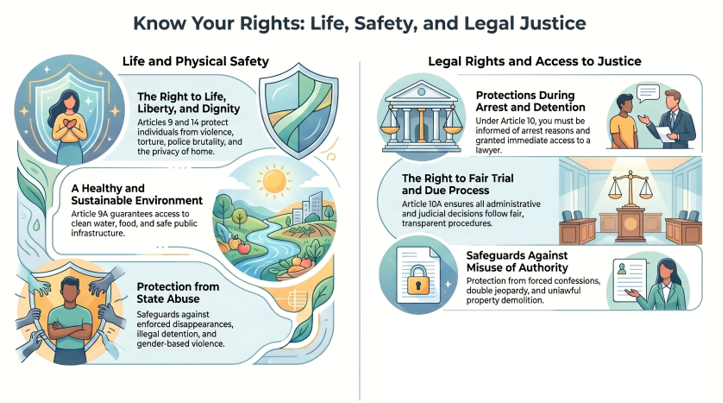
No one can be deprived of their life or freedom unless the law specifically allows it. This right means more than just staying alive, as courts have ruled that it includes the right to live with dignity, breathe clean air, and be governed honestly. The government is not just forbidden from harming its citizens but is also responsible for protecting them from dangers like unlawful violence, crumbling infrastructure, and environmental threats.
No one can simply be picked up and thrown in jail without reason. If you are arrested, the authorities must tell you why, and you have the right to call a lawyer. If the government wants to detain someone as a precaution, it can only do so within very strict legal boundaries and must have the case reviewed regularly. The law exists to make sure that the power to arrest is never used as a weapon against ordinary people.
Every person, whether involved in a civil matter or facing a criminal charge, has the right to a fair trial. This means you cannot be punished without being properly heard. The government cannot create a new law and use it to punish something you did in the past. You cannot be tried twice for the same crime, and you cannot be forced to testify against yourself. A fair trial means having a lawyer, being able to question witnesses, and getting a decision in a reasonable amount of time.
Every person’s dignity is protected by the Constitution. No government official or state institution can torture, humiliate, or degrade any citizen. Everyone is equal before the law, regardless of whether they are rich or poor, what religion they follow, what caste they belong to, or whether they are a man or a woman. The government must treat every person fairly in its courts, its offices, and its public services. Protecting dignity is not just about preventing harm but about building a system where every person can live and seek justice freely.
Enforcement and Access to Justice
Under Article 199, any citizen whose rights have been violated can approach the High Court, which has the power to issue legal orders against unlawful government actions — including releasing someone wrongfully imprisoned or stopping an illegal state decision. At the federal level, Article 175E establishes the Federal Constitutional Court, created through the 27th Amendment in November 2025, as Pakistan’s highest forum for constitutional matters. This court took over the public interest jurisdiction previously held by the Supreme Court under Article 184(3), meaning any citizen can now petition it when the state oversteps its legal boundaries. Together, these articles ensure that no government action is above the law and every person has a constitutional door to seek justice.
Relevant Rights
Isssues Covered:
- Protection from illegal arrest
- Protection from unlawful detention
- Right to be informed of reasons for arrest
- Right to access a lawyer
- Protection from detention without court production
- Protection from forced confession
- Protection from torture during investigation
- Protection from being punished twice for the same offence
- Protection from punishment under laws applied backward
- Right to fair trial and due process
- Government action without notice or hearing
- Administrative decisions passed without fair procedure
- Unfair disciplinary action by public institutions
- Job termination without inquiry
- Student expulsion without hearing
- Admission denied without reason
- Demolition, eviction, or cancellation orders without due process
- Misuse of police or government authority
- Challenging unconstitutional laws, policies, or state actions
Women’s Rights
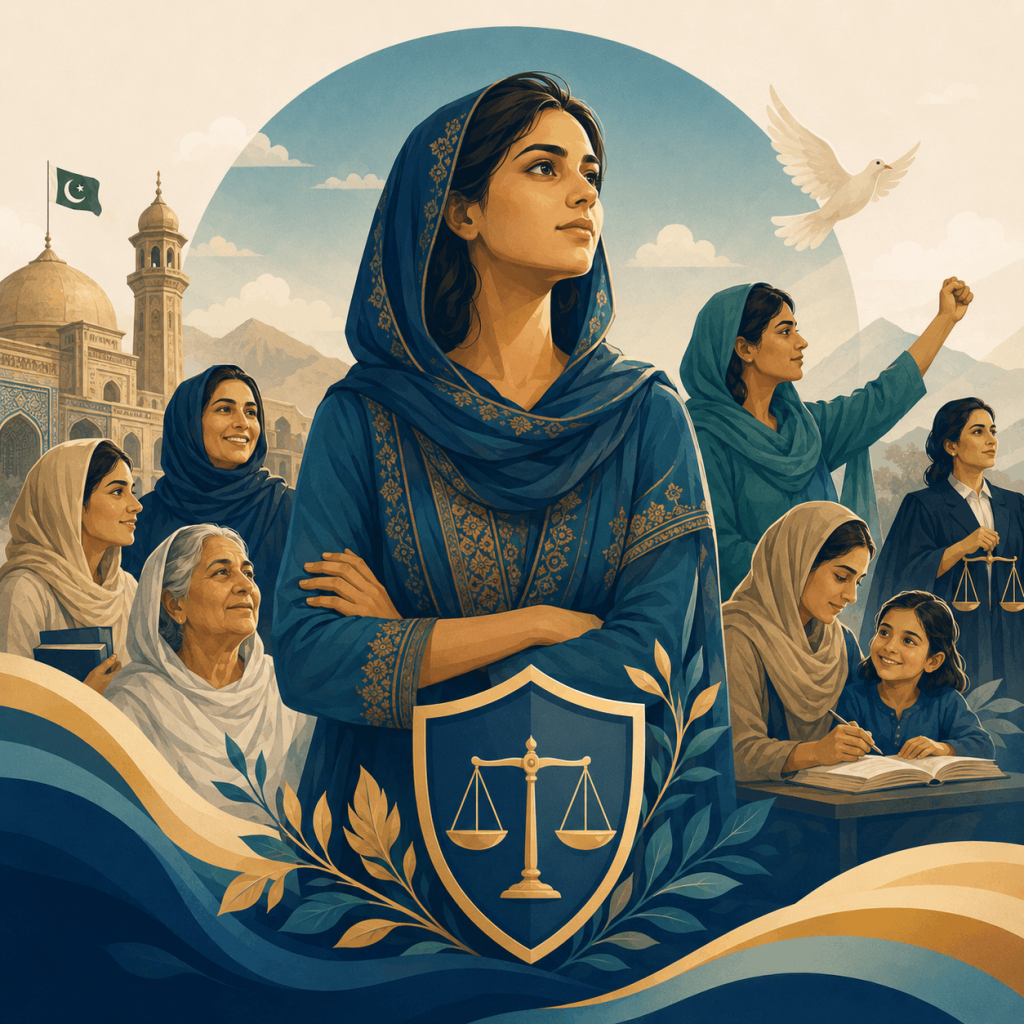
This outlines the fundamental legal protections and civil liberties guaranteed to women according to specific constitutional articles.
It emphasizes the importance of gender equality, ensuring that women have equal standing before the law and unrestricted access to both education and public spaces.
The text details critical safeguards against harassment, violence, and abuse to ensure personal safety and the preservation of human dignity.
Furthermore, it addresses economic fairness by advocating for inheritance rights and the removal of discriminatory barriers in professional environments.
Ultimately, these guidelines establish a comprehensive framework for protecting the autonomy and security of women in both private and public life.
Relevant Rights
Isssues Covered:
- Protection from harassment and violence
- Right to dignity and privacy
- Equal treatment before law
- Women’s right to education
- Women’s right to inheritance and property
- Discrimination at work or in public employment
- Access to public places without discrimination
- Protection from forced or unsafe living conditions
Minority Rights
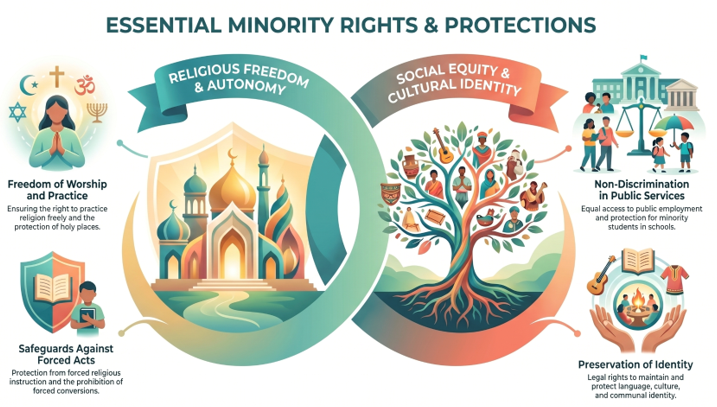
This outlines a framework of fundamental protections designed to safeguard the interests of marginalized communities.
These provisions ensure that individuals can freely practice their faith and preserve their unique cultural and linguistic identities without fear of interference.
The documents specifically prohibit religious discrimination within public sectors, such as government employment and educational institutions.
Furthermore, the source highlights legal barriers against forced conversions and the desecration of sacred places of worship.
By establishing these civic safeguards, the text illustrates a commitment to maintaining social equality and individual liberty.
Overall, the articles serve as a comprehensive guide to upholding the human rights of minority groups within a diverse society.
Relevant Rights
Isssues Covered:
- Right to practice religion freely
- Protection from forced religious instruction
- Discrimination against minority students
- Protection of places of worship
- Religious discrimination in public services
- Minority access to public employment
- Protection from forced conversions
- Preservation of language, culture, and identity
Children’s Rights
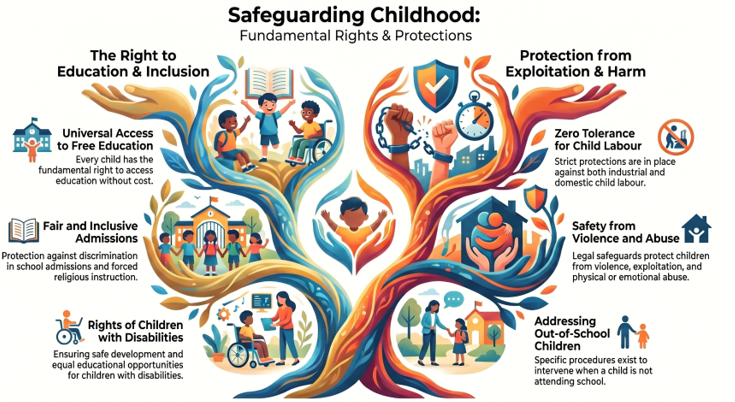
This document details the fundamental legal protections and entitlements afforded to minors, emphasizing their right to a safe development.
A primary focus is placed on educational access, ensuring that children can attend school without facing discrimination or being coerced into religious instruction.
The text also highlights the necessity of shielding youth from harmful practices like forced labor, domestic servitude, and various forms of abuse or exploitation.
Additionally, it addresses the specific needs and rights of children with disabilities to ensure they are not marginalized.
By outlining these specific articles, the source provides a clear framework for identifying and addressing violations of children’s rights.
Overall, the material serves as a guide for protecting the well-being and future of all young citizens.
Relevant Rights
Isssues Covered:
- Every child’s right to free education
- Protection from child labour
- Protection from domestic child labour
- Protection from abuse, violence, and exploitation
- Rights of children with disabilities
- Discrimination in school admissions
- Protection from forced religious instruction
- What to do if a child is out of school
Marriage and Family Rights
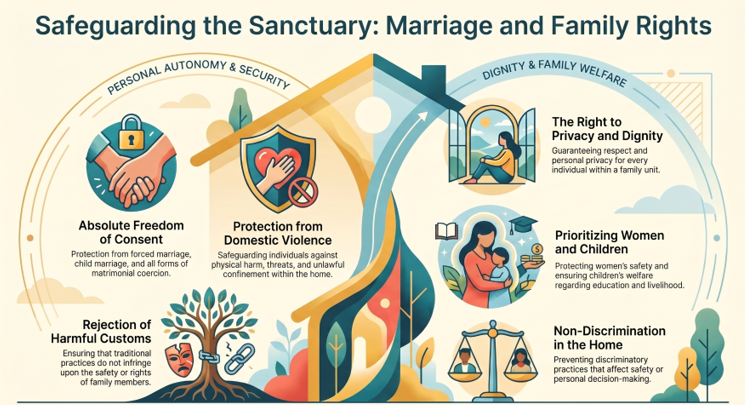
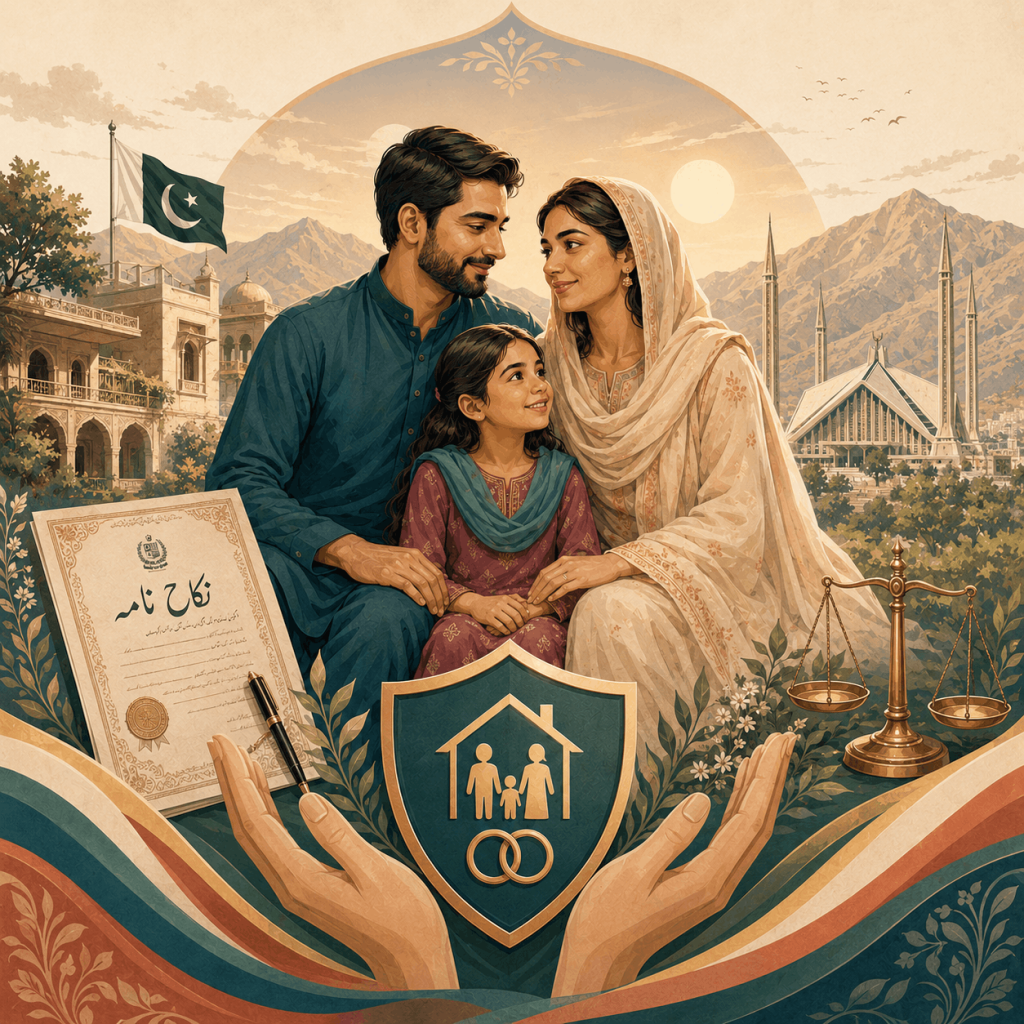
This umbrella of articles cover the legal and ethical protections designed to safeguard the integrity of the family unit and its individual members.
It emphasizes the necessity of mutual consent, specifically prohibiting forced or child marriage while promoting the fundamental right to personal dignity.
A significant portion of the text focuses on ensuring safety from domestic violence and eliminating harmful cultural practices that threaten women and children.
Furthermore, the source advocates for the preservation of private life and the prevention of unlawful coercion regarding personal livelihood or education.
By prioritizing equality and welfare, these guidelines aim to dismantle discrimination within domestic and community settings.
Ultimately, the material serves as a framework for protecting human rights against threats and confinement in the pursuit of a secure family environment.
Relevant Rights
Isssues Covered:
- Protection from forced marriage
- Right to dignity and privacy in family life
- Protection from domestic violence
- Protection from harmful customs
- Women’s safety within marriage and family
- Child marriage concerns
- Family decisions affecting education, livelihood, or safety
- Protection from coercion, threats, or unlawful confinement
Work and Employment Rights
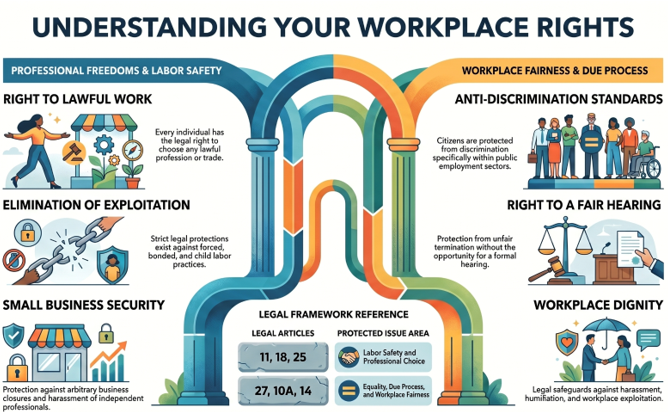
It outlines the fundamental legal protections and workplace rights guaranteed to individuals within a professional environment.
It emphasizes the freedom for citizens to pursue lawful employment while strictly prohibiting abusive practices such as forced labor and child exploitation.
The text details safeguards against discriminatory hiring and ensures that employees are shielded from unfair dismissal or workplace harassment.
Furthermore, it addresses the necessity of protecting small businesses and professionals from arbitrary closures or systemic interference.
By citing specific legal articles, the source establishes a framework for fair treatment and dignity across all sectors of the economy.
Relevant Rights
Isssues Covered:
- Right to choose lawful work or profession
- Protection from forced labour and bonded labour
- Protection from child labour
- Discrimination in public employment
- Unfair termination without hearing
- Workplace harassment or humiliation
- Arbitrary closure of workplace or business
- Harassment of small businesses and professionals
Digital Rights and Privacy
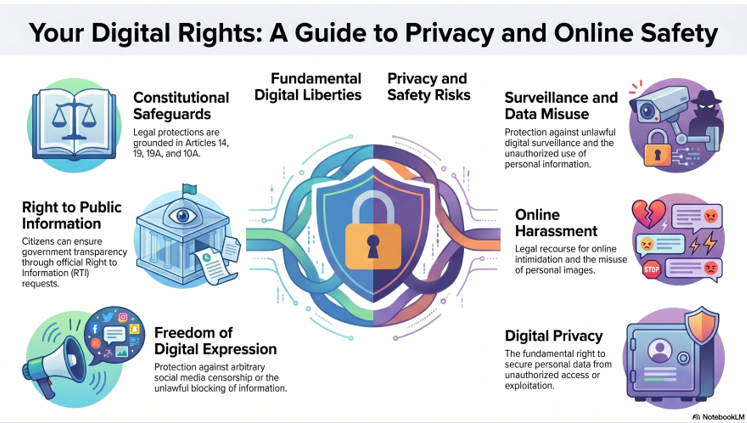
This covers the fundamental legal protections and challenges associated with the modern internet landscape.
It specifically addresses how individuals are shielded from online harassment, intimidation, and the unauthorized use of their personal images or data.
Furthermore, the source examines the critical boundaries of government surveillance and social media censorship to ensure that digital expression remains free.
A significant emphasis is placed on the right to access public information, highlighting how transparency is maintained through formal requests.
By referencing specific legal articles, the text serves as a framework for understanding digital rights and individual privacy in a connected society.
Relevant Rights
Isssues Covered:
- Protection from online harassment
- Misuse of personal data or images
- Unlawful surveillance
- Digital privacy and personal information
- Social media censorship or blocking
- Online intimidation
- Right to access public information
- Government transparency through RTI requests
Environment and Climate Rights
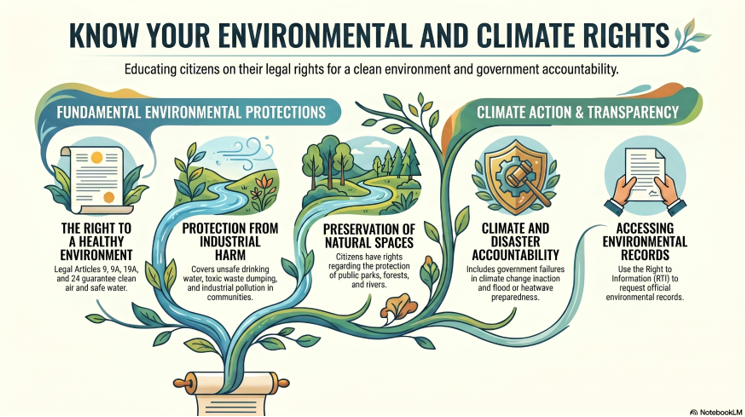
This outlines the fundamental entitlements to a clean and healthy environment, specifically referencing legal protections against various forms of ecological degradation.
It addresses critical public health concerns such as polluted air, toxic waste disposal, and contaminated drinking water that threaten local communities.
The text further examines the responsibilities of authorities regarding climate change mitigation, including the management of extreme weather events like floods and heatwaves.
Additionally, it highlights the importance of preserving natural resources such as forests and public parks from industrial damage and deforestation.
Finally, the source provides guidance on how citizens can participate in environmental decision-making by accessing official records through transparency laws.
These combined elements establish a comprehensive framework for understanding and defending ecological and climate-related rights.
Relevant Rights
Isssues Covered:
- Right to clean and healthy environment
- Unsafe drinking water
- Air and water pollution
- Industrial pollution affecting communities
- Toxic waste dumping
- Deforestation and damage to public parks
- Climate change inaction
- Flood and heatwave preparedness failures
- How to ask for environmental records through RTI
Health Rights
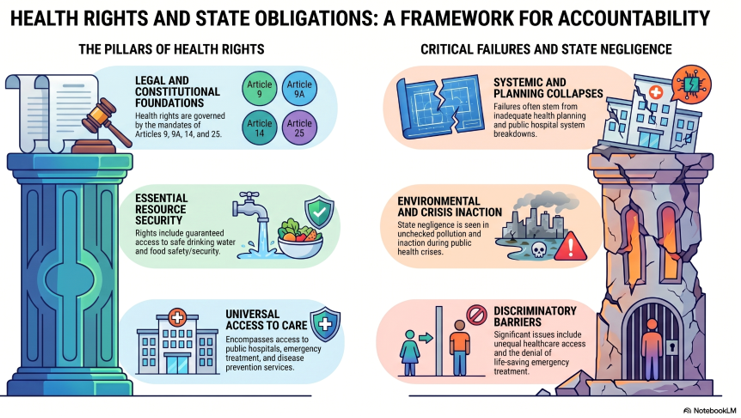
This outlines the fundamental legal framework and state obligations regarding public health and safety.
It details critical protections such as the right to emergency medical care and the necessity of maintaining functional public hospital systems.
Beyond clinical settings, the document emphasizes the state’s duty to provide safe drinking water, food security, and pollution control to protect citizens.
It also addresses legal accountability for government negligence, specifically focusing on failures in disaster planning and crisis management.
Ultimately, these regulations aim to ensure equitable healthcare access and prevent systemic failures that jeopardize community well-being.
Relevant Rights
Isssues Covered:
- Failure of public hospitals or health systems
- Denial of emergency treatment
- Unsafe drinking water affecting health
- Pollution affecting public health
- Food insecurity and malnutrition
- Lack of public health planning
- Unequal access to healthcare
- State inaction during public health crises
Education Rights
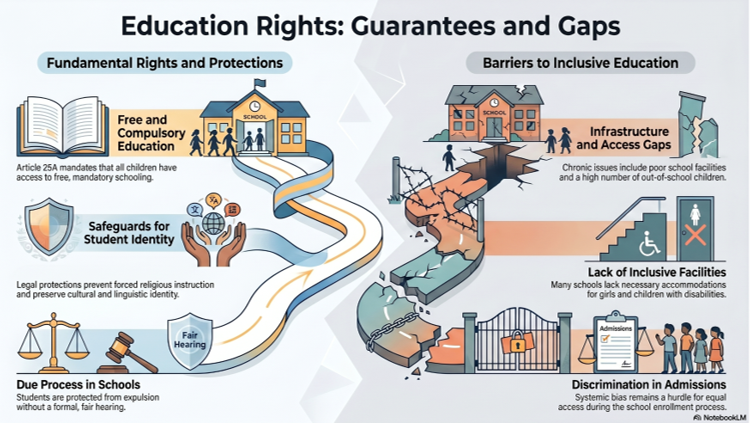
This details the legal framework and fundamental human rights associated with the educational system.
It highlights the state’s obligation to provide free and mandatory schooling while addressing critical barriers like dilapidated infrastructure and the high number of out-of-school youth.
The text emphasizes the necessity of inclusive environments, specifically advocating for improved resources for female students and children with disabilities.
Furthermore, it outlines protections against religious coercion and discriminatory admission practices to ensure equitable access for all.
By referencing specific legal articles, the source establishes a mandate for fair disciplinary procedures and the preservation of cultural and linguistic identities.
Ultimately, these guidelines serve as a comprehensive blueprint for upholding educational equity and student safety.
Relevant Rights
Isssues Covered:
- Failure of public hospitals or health systems
- Denial of emergency treatment
- Unsafe drinking water affecting health
- Pollution affecting public health
- Food insecurity and malnutrition
- Lack of public health planning
- Unequal access to healthcare
- State inaction during public health crises
Housing, Property and Land Rights
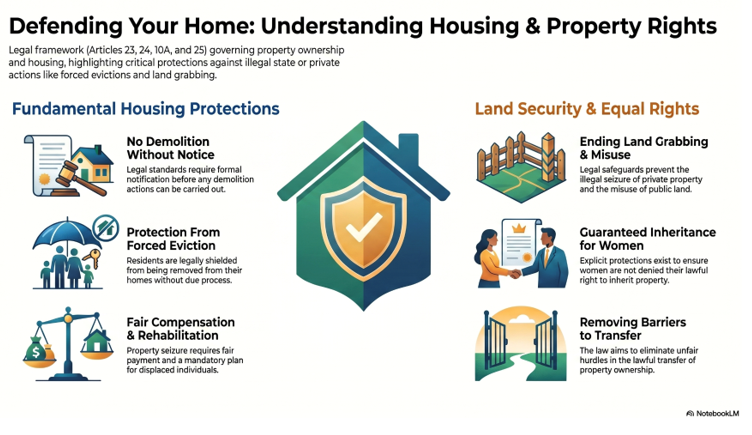
This outlines the fundamental legal protections and systemic challenges associated with housing and property rights.
It specifically addresses the prevention of unlawful evictions and the destruction of property without proper notification or financial restitution.
The text also highlights critical social inequities, such as gender-based inheritance denial and the forced displacement of individuals without rehabilitation support.
Furthermore, it examines the misuse of public land and the presence of obstacles that prevent the legal transfer of ownership.
Ultimately, these articles serve as a framework for safeguarding citizens against land grabbing and exploitative development projects.
Relevant Rights
Isssues Covered:
- Protection from forced eviction
- Demolition without notice
- Property taken without compensation
- Land grabbing
- Women denied inheritance
- Displacement without rehabilitation
- Public land misuse
- Unfair development schemes
- Barriers to lawful property transfer
Freedom of Speech and Civic Participation
Civic Liberty and the Right to Public Expression
The provided document details the fundamental components of freedom of expression and civic involvement within a legal framework.
It outlines essential protections for peaceful assembly and the formation of unions or associations, which allow citizens to organize effectively.
The text also emphasizes the importance of political participation and the right to hold public authorities accountable through criticism and information requests.
Furthermore, it addresses significant threats to these liberties, such as media censorship, harassment of journalists, and limitations on movement.
By referencing specific legal articles, the source establishes a formal basis for transparency and the protection of democratic engagement.
Overall, the material serves as a comprehensive overview of the rights and challenges associated with public discourse and activism.
Relevant Rights
Isssues Covered:
- Right to peaceful protest
- Right to form associations or unions
- Right to political participation
- Restrictions on movement
- Censorship and media harassment
- Threats to journalists
- Right to criticize public authorities
- Right to ask for public records